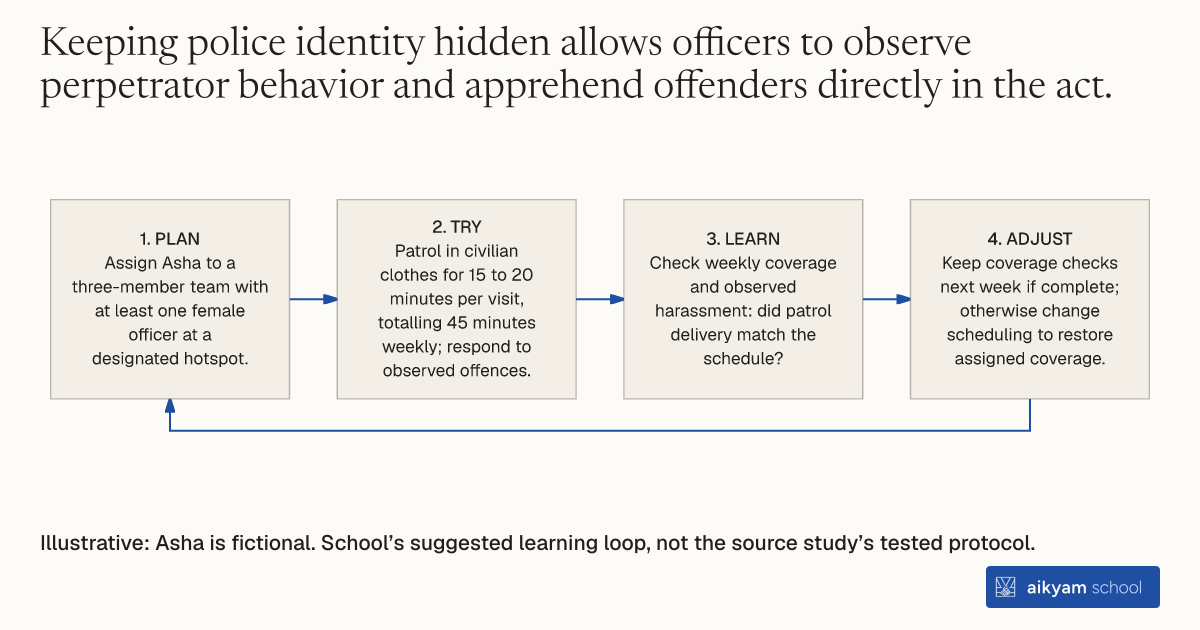
Try, learn and adjust
Check plainclothes patrol delivery
- Plan: Assign Asha to a three-member team with at least one female officer at a designated hotspot.
- Try: Patrol in civilian clothes for 15 to 20 minutes per visit, totalling 45 minutes weekly; respond to observed offences.
- Learn: Check weekly coverage and observed harassment: did patrol delivery match the schedule?
- Adjust: Keep coverage checks next week if complete; otherwise change scheduling to restore assigned coverage.
Illustrative: Asha is fictional. School’s suggested learning loop, not the source study’s tested protocol.
See source →School’s suggested, untested learning loop. Observe patrol minutes and observed offences; undercover patrols did not reduce mild or severe harassment in the study.
How
When to use
Street harassment in urban public spaces often goes unpunished because perpetrators evade visible law enforcement presence. Police departments seek to catch and apprehend offenders directly in the act without alerting them in advance. Deploy undercover officers wearing civilian clothing to monitor designated high-risk hotspots and apprehend perpetrators during harassment incidents.
Deploy specialized police teams wearing plain civilian clothes to conduct covert patrolling across high-risk public hotspots.
- Assign three-member police teams containing at least one female officer to designated harassment hotspots on weekly schedules.
- Require team members to wear plain civilian clothing during their patrol shifts to keep their police identity hidden.
- Schedule patrol teams to spend 15 to 20 minutes per visit at each assigned hotspot, accumulating 45 minutes of weekly patrol coverage per location.
- Monitor public areas covertly to detect active instances of mild and severe sexual harassment.
- Intervene upon observing offenses to apprehend perpetrators, issue formal warnings, and transport offenders to police stations.
Why it works
However, because plainclothes officers lack visible presence, covert patrols fail to provide a visible deterrent to prevent harassment from occurring.
Example
Hyderabad City Police assigned 100 hotspots in Hyderabad, India, to undercover officers who patrolled in civilian clothes for 45 minutes per week over the study period.
About the study
Participants
100 hotspots in Hyderabad, India.
Study Design
A randomized controlled trial evaluating undercover police patrols in civilian clothes against 100 uniformed patrol hotspots and 150 unpatrolled comparison hotspots.
Results
Undercover patrols wearing civilian clothing did not reduce the frequency of severe sexual harassment or mild sexual harassment compared to unpatrolled hotspots.