Research design
Randomly offer balance-sharing cards
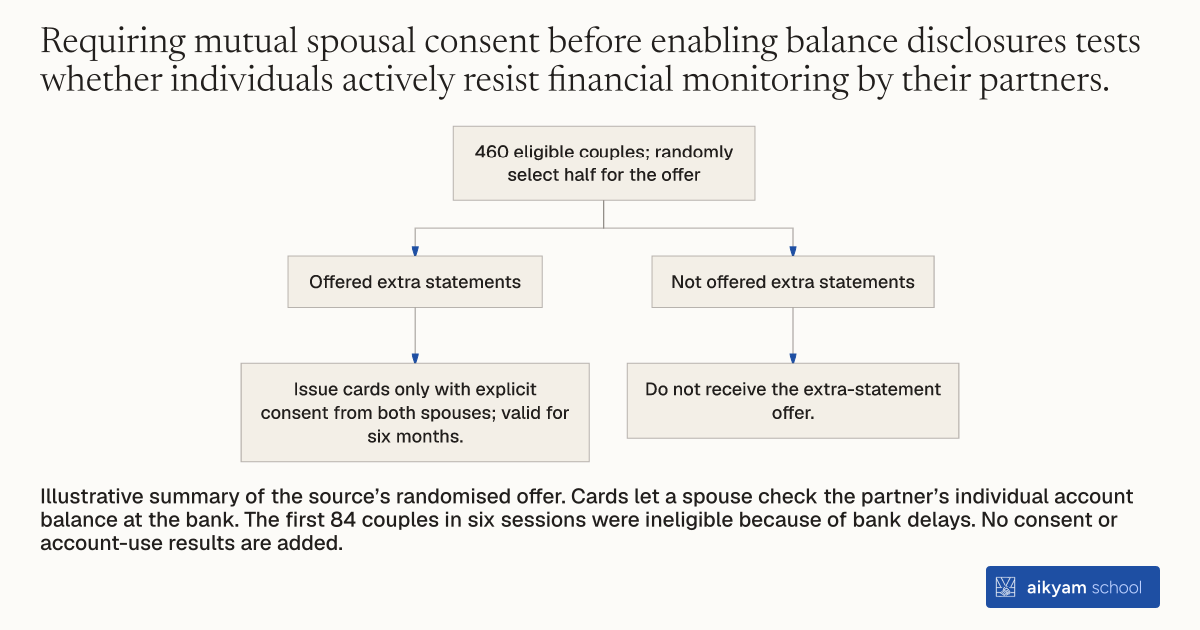
460 eligible couples; randomly select half for the offer
- Offered extra statements
- Issue cards only with explicit consent from both spouses; valid for six months.
- Not offered extra statements
- Do not receive the extra-statement offer.
Illustrative summary of the source’s randomised offer. Cards let a spouse check the partner’s individual account balance at the bank. The first 84 couples in six sessions were ineligible because of bank delays. No consent or account-use results are added.
See source →How
When to use
Researchers or financial practitioners need to evaluate whether hidden savings motives drive individuals to choose private accounts over joint accounts. In many married households, spouses may prefer individual bank accounts specifically to conceal financial balances from each other. Randomly offering spousal balance-lookup vouchers with mutual consent enables testing how transparency affects private account adoption and usage.
Offer married couples opening individual bank accounts the option to enable spousal account balance verification through physical statement cards.
- Randomly select half of participating married couples during financial account enrollment sessions to receive an extra statements offer.
- Require enumerators processing individual account paperwork to ask if the opening spouse consents to grant their partner balance-lookup privileges.
- Require explicit mutual consent from both spouses before issuing any extra statement authorization cards.
- Issue physical statement cards to the consenting spouse that entitle them to learn the current balance of their partner's individual account upon presentation at the bank branch.
- Limit the validity of the extra statement authorization cards to a fixed six-month period following account setup.
Why it works
If information hiding is a primary reason for using private bank accounts, offering spousal statement lookup cards reduces account demand or prompts lower consent among spouses seeking financial secrecy.
Example
In Western Kenya near Busia town, 50 percent of eligible married couples were randomly offered extra statement cards allowing one spouse to check the other's individual bank balance, resulting in a 69 percent spousal consent rate among offered couples.
About the study
Participants
460 married couples across 27 experimental sessions in Western Kenya near Busia town (84 couples in the first 6 sessions were ineligible due to administrative bank delays).
Study Design
Randomized controlled trial offering 50 percent of eligible couples extra statement cards that allowed a spouse to verify their partner's individual bank account balance for 6 months, conditional on mutual consent.
Results
Overall 69 percent of individuals consented to the extra statements (68.2 percent of men and 69.2 percent of women), and poorly informed or poorly matched couples responded more adversely to the treatment.