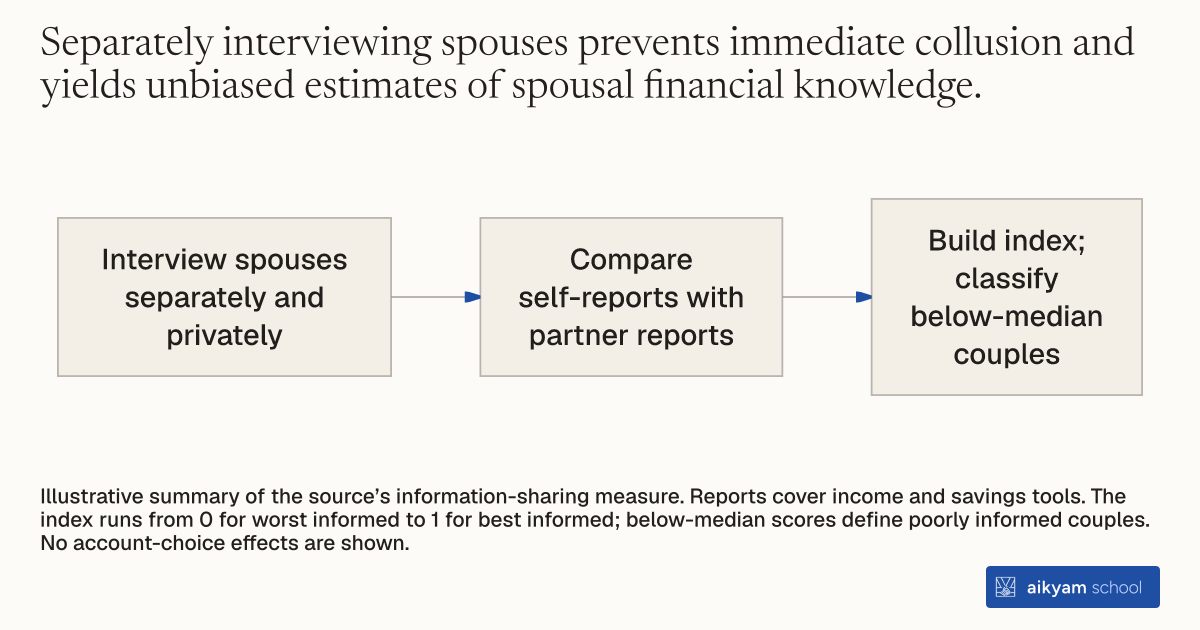
Research procedure
Compare spouses’ financial reports
- Interview spouses separately and privately
- Compare self-reports with partner reports
- Build index; classify below-median couples
Illustrative summary of the source’s information-sharing measure. Reports cover income and savings tools. The index runs from 0 for worst informed to 1 for best informed; below-median scores define poorly informed couples. No account-choice effects are shown.
See source →How
When to use
Researchers or organizations need to evaluate intrahousehold financial transparency and hidden information between spouses. In rural households, spouses may keep income and savings secret to protect private consumption or preserve bargaining power. Constructing a standardized index from cross-reported income and financial tool use identifies poorly informed couples.
Construct an information sharing index by comparing each spouse's self-reported finances with their partner's cross-reports during separate interviews.
- Administer individual baseline surveys to husbands and wives separately so responses remain private.
- Elicit self-reported weekly income, bank account usage, SACCO membership, and informal savings group participation from each spouse.
- Ask each spouse to report their partner's weekly income and financial account participation.
- Calculate individual reporting accuracy by comparing self-reports against spousal cross-reports.
- Aggregate spousal accuracy scores into a single composite index ranging from zero for worst-informed couples to one for best-informed couples.
- Categorize couples with scores below the sample median as poorly informed to analyze hidden information dynamics.
Why it works
Comparing self-reports against spousal cross-reports creates an objective benchmark of intrahousehold information flow.
Example
In Western Kenya near Busia town, researchers surveyed married couples separately on income and savings tools, creating an information sharing index that categorized 51 percent of 472 responding couples as poorly informed below the median score.
About the study
Participants
472 married couples (944 individuals) in Western Kenya near Busia town, excluding 84 couples in the first six experimental sessions.
Study Design
Separate baseline survey interviews eliciting individual income and savings tool use alongside cross-reports of spousal financial activity to construct a zero-to-one information sharing index.
Results
Slightly over half (50.6 percent of well-matched and 52.3 percent of badly matched) of couples were coded as poorly informed below the median index value, and poorly informed couples were significantly more likely to choose dominated individual bank accounts.