Research steps
Record spousal negotiation and conflict
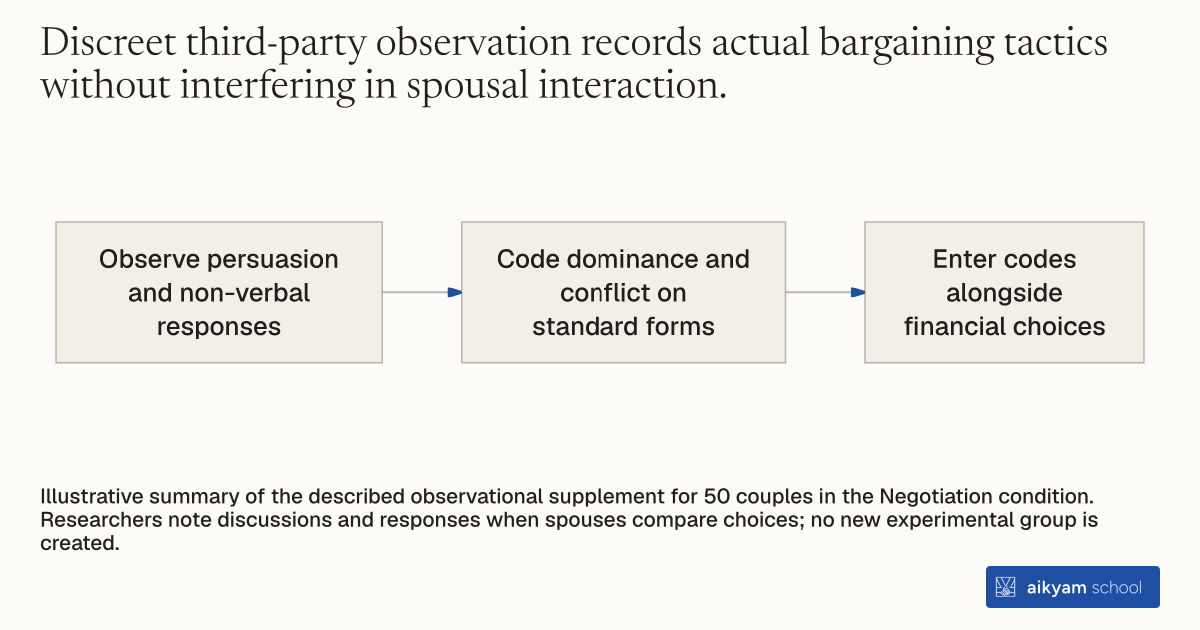
- Observe persuasion and non-verbal responses
- Code dominance and conflict on standard forms
- Enter codes alongside financial choices
Illustrative summary of the described observational supplement for 50 couples in the Negotiation condition. Researchers note discussions and responses when spouses compare choices; no new experimental group is created.
See source →How
When to use
In intra-household studies, self-reported survey data can obscure active bargaining tactics and emotional friction between spouses. Direct observation captures real-time communication dynamics during joint financial choices. This protocol records unobtrusive qualitative and quantitative measures of spousal persuasion, dominance, and disagreement.
Track and code real-time spousal communication and bargaining behaviors during joint decision-making exercises.
- Local research assistants position themselves at nearby tables while couples conduct joint financial decisions.
- Assistants discreetly observe verbal arguments, non-verbal expressions, and persuasion attempts between husbands and wives.
- Assistants code qualitative supplements for each individual decision to record which spouse dominates the negotiation.
- Assistants note specific verbal persuasion tactics, including references to household duty, family well-being, or children's names.
- Assistants complete a structured form recording spousal responses, discussion dynamics, and emerging conflict when couples compare choices.
- Local staff enter qualitative scores into the experimental database alongside recorded allocation choices.
Why it works
Standardized coding sheets convert spontaneous negotiation behaviors into measurable data on intra-household dominance and conflict.
Example
Local research assistants discreetly coded negotiation dynamics for 50 married couples at Green Bank in Mindanao, Philippines. The coding revealed that women repeatedly used persuasive statements such as "remember you have a family" and called out children's names to persuade husbands to deposit money into the wife's bank account.
About the study
Participants
50 married couples (100 individuals) in the Negotiation treatment recruited near Green Bank in Mindanao, Philippines.
Study Design
Observational qualitative supplement coding spousal dominance, persuasion arguments, and conflict during joint financial decision sessions.
Results
Spousal dominance in negotiation was significantly correlated at the 5 percent level with older age (correlation coefficient = 0.21) and higher education (correlation coefficient = 0.23).