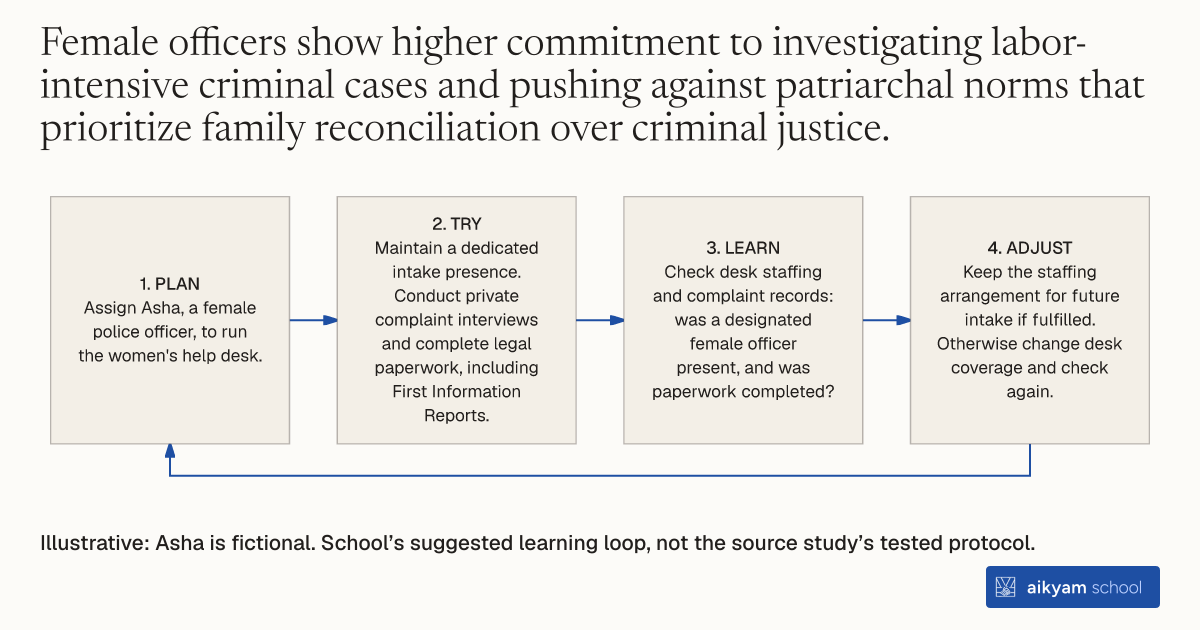
Try, learn and adjust
Check designated female officers staff intake
- Plan: Assign Asha, a female police officer, to run the women's help desk.
- Try: Maintain a dedicated intake presence. Conduct private complaint interviews and complete legal paperwork, including First Information Reports.
- Learn: Check desk staffing and complaint records: was a designated female officer present, and was paperwork completed?
- Adjust: Keep the staffing arrangement for future intake if fulfilled. Otherwise change desk coverage and check again.
Illustrative: Asha is fictional. School’s suggested learning loop, not the source study’s tested protocol.
See source →School's suggested, untested loop: observe staffing, private intake and paperwork; these checks do not establish effects on criminal filings.
How
When to use
Female complainants often face male-dominated police stations where male officers dismiss complaints or prioritize family reconciliation over law enforcement. Female officers make up only seven percent of the police force and are rarely assigned to intake roles. This method assigns designated female officers to staff help desks in mixed-gender stations to handle gender-based violence complaints.
Assign designated female officers to manage women's help desks inside police stations to process reports of violence against women.
- Police station administrators designate female officers within existing station personnel to staff help desk positions.
- Station leaders ensure assigned female officers maintain dedicated presence at intake desks to greet arriving female complainants.
- Designated female officers conduct private intake sessions and record details of gender-based violence complaints.
- Assigned female officers complete legal paperwork, including labor-intensive First Information Reports that open criminal investigations.
Why it works
Their presence provides dedicated accountability and agency within male-dominated police station environments.
Example
Madhya Pradesh Police assigned female officers to run help desks across 59 stations in 12 districts with 90 percent compliance, driving 3,360 additional First Information Reports filed for crimes against women.
About the study
Participants
180 police stations across 12 districts in Madhya Pradesh, India, serving average station catchment populations of 130,000 citizens.
Study Design
Randomized controlled trial comparing 59 woman-run help desk stations (90 percent compliance), 61 regular help desk stations (72 percent male-led), and 60 control stations from May 2019 to October 2020.
Results
Woman-run help desks drove a 14 percent increase in criminal First Information Reports for crimes against women (averaging 4.4 per month versus 3.8 in control stations), while regular male-led help desks showed no significant increase in criminal filings.