Research steps
Randomise subsidy timing across cohorts
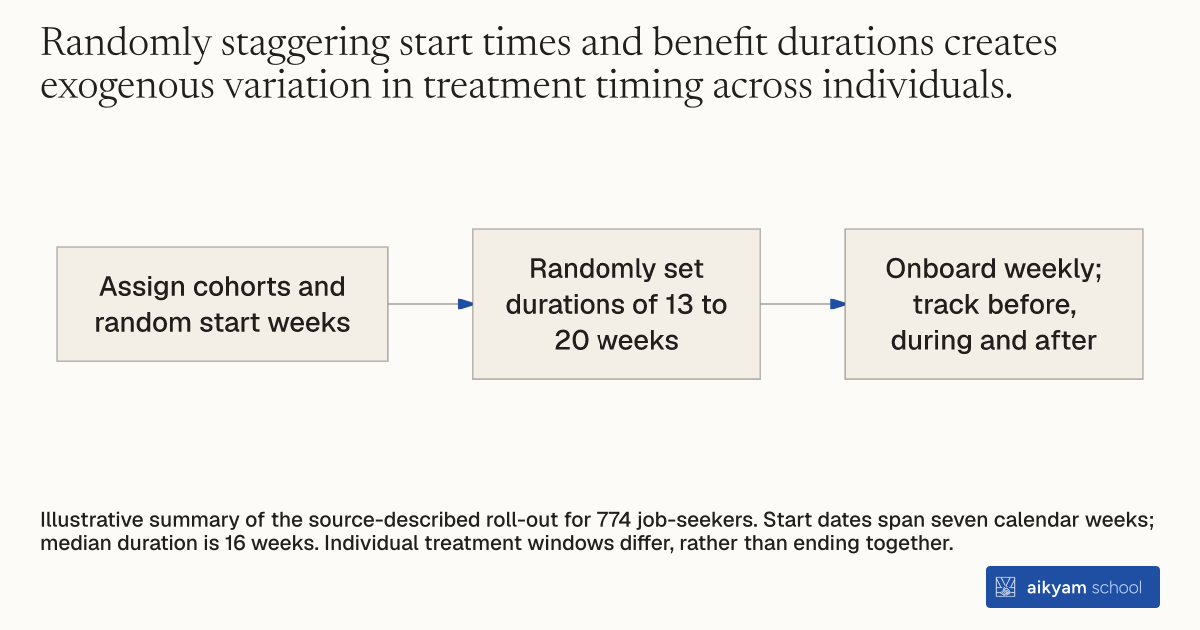
- Assign cohorts and random start weeks
- Randomly set durations of 13 to 20 weeks
- Onboard weekly; track before, during and after
Illustrative summary of the source-described roll-out for 774 job-seekers. Start dates span seven calendar weeks; median duration is 16 weeks. Individual treatment windows differ, rather than ending together.
See source →How
When to use
Deploying a social support program to a large participant pool creates administrative bottlenecks if launched simultaneously. Ending benefits for all recipients at once creates artificial cliff effects and complicates temporal impact tracking. Stagger start dates and program durations across participants to smooth operational logistics and create exogenous temporal variation.
Schedule intervention start times and duration lengths across participants in a randomized, staggered sequence.
- Assign eligible participants to program cohorts prior to intervention launch.
- Randomly select start weeks for each participant across a multi-month onboarding window.
- Randomly vary benefit duration lengths across participants between 13 and 20 weeks.
- Onboard incoming cohorts weekly according to their designated start dates.
- Track weekly outcome indicators before, during, and after individual treatment windows.
Why it works
This prevents administrative capacity constraints from compromising delivery quality and allows researchers to separate time-elapsed treatment trajectories from calendar week shocks.
Example
Researchers staggered transport subsidy access for 774 young job-seekers in Addis Ababa, Ethiopia between September 2014 and January 2015. Onboarding start dates spanned seven calendar weeks, with individual subsidy durations varying randomly from 13 to 20 weeks (median 16 weeks).
About the study
Participants
N = 774 young job-seekers aged 18–29 in Addis Ababa, Ethiopia assigned to transport subsidies.
Study Design
Randomized staggered roll-out design varying start dates across 7 calendar weeks and duration lengths between 13 and 20 weeks.
Results
Staggered implementation generated exogenous variation in active treatment status across calendar weeks, enabling quadratic trend estimation that identified a 12.5% increase in job search probability during active subsidy weeks.