Try, learn and adjust
Check records from staggered job-fair sessions
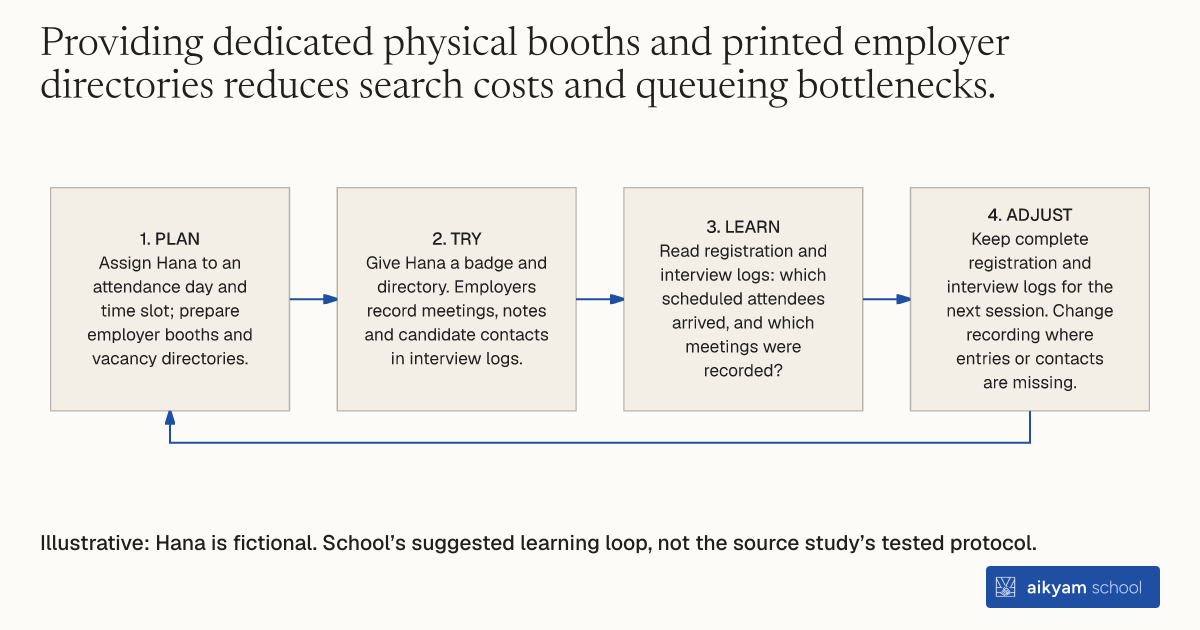
- Plan: Assign Hana to an attendance day and time slot; prepare employer booths and vacancy directories.
- Try: Give Hana a badge and directory. Employers record meetings, notes and candidate contacts in interview logs.
- Learn: Read registration and interview logs: which scheduled attendees arrived, and which meetings were recorded?
- Adjust: Keep complete registration and interview logs for the next session. Change recording where entries or contacts are missing.
Illustrative: Hana is fictional. School’s suggested learning loop, not the source study’s tested protocol.
See source →School’s suggested, untested loop. Observe scheduled attendance and recorded meetings; no interview, offer or hire is assumed for Hana.
How
When to use
Use this method when organizing physical matching events between formal employers and young jobseekers in dense urban developing markets. It solves the problem of high search costs, spatial congestion, and disorganized interactions at large job events. It serves labor market intermediaries, government employment centers, and event organizers seeking structured face-to-face recruitment.
Organize structured sector-specific physical booths across staggered attendance sessions to facilitate direct employer-jobseeker interaction.
- Rent a central venue with large hall capacity and set up individual booths equipped with company name signs, tables, and chairs for each invited firm.
- Print directory booklets listing attending employers, entry requirements, salary ranges, and job vacancy descriptions.
- Assign jobseekers to specific attendance days and time slots to prevent venue overcrowding and control crowd density.
- Issue personalized identification badges and directory booklets to workers and firm representatives at registration desks upon arrival.
- Provide firm representatives with structured interview logs to record meeting notes and candidate contact details during stall visits.
Why it works
Staggering attendee arrival times maintains manageable queue lengths so firm representatives can conduct meaningful face-to-face interviews.
Example
Researchers in Addis Ababa, Ethiopia hosted two two-day job fairs at a central exhibition venue, inviting 248 formal firms and 1,007 jobseekers across staggered shifts. A total of 170 firms and 606 jobseekers attended, generating hundreds of structured face-to-face screening interviews over four event days.
About the study
Participants
N = 1,007 invited jobseekers and N = 248 invited formal firms (606 jobseekers and 170 firms attended) in Addis Ababa, Ethiopia.
Study Design
Field experiment randomized trial with two-day staggered physical job fairs featuring individual firm booths, company directories, and scheduled arrival shifts.
Results
60% of invited jobseekers and 69% of invited firms attended the job fairs, yielding an average of 3.5 firm meetings per attending jobseeker and a total of 137 formal job offers.