In Simple Words
Imagine a speed-dating event with hundreds of participants where people wander aimlessly and queue at popular tables. Instead of random mingling, a central coordinator collects basic background profiles from everyone beforehand and uses an automated preference-matching rule to print a personalized schedule of 10 targeted meetings for each person, ensuring attendees meet partners who actually fit their criteria.
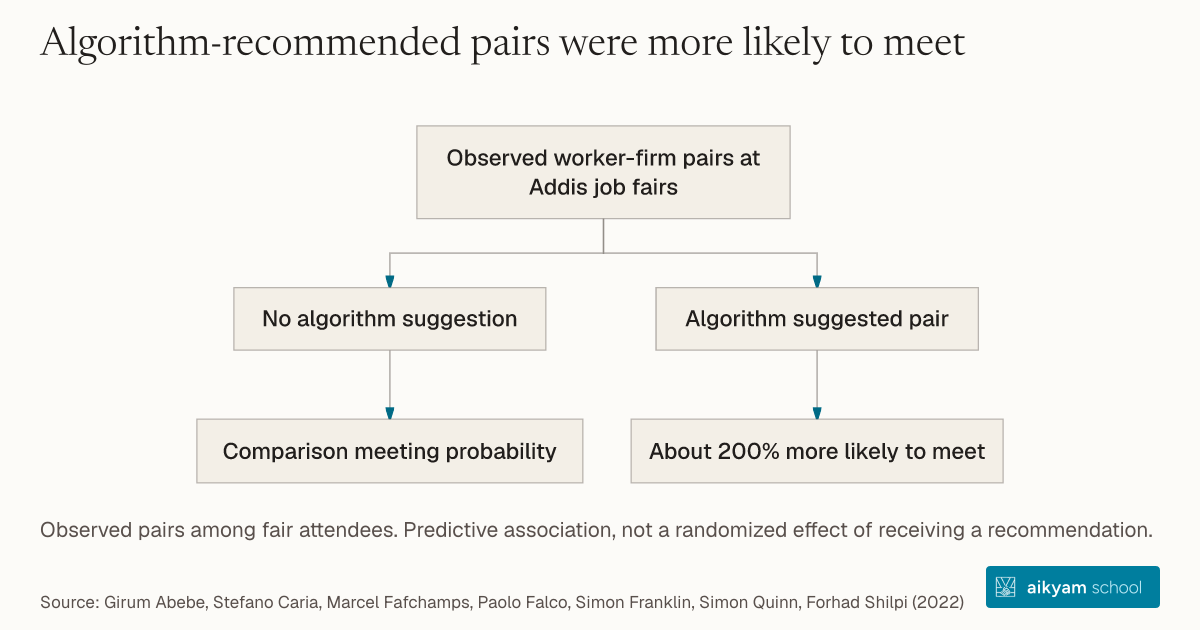
Observed worker-firm pairs at Addis job fairs
- No algorithm suggestion
- Comparison meeting probability
- Algorithm suggested pair
- About 200% more likely to meet
Observed worker-firm pair comparison among attendees. Algorithm-recommended pairs were more likely to meet; this association does not isolate a causal recommendation effect.
See source →Research question
Large multi-employer job fairs often suffer from high search and congestion costs, where attendees waste time in random, low-probability encounters. Unstructured interactions prevent firms and jobseekers from identifying mutually beneficial matches within limited event timeframes.
Participants
N = 1,007 invited jobseekers and N = 248 invited formal firms (606 jobseekers and 170 firms attending across two two-day job fairs) evaluated via dyadic regressions on 27,778 worker-firm pairings in Addis Ababa, Ethiopia.
Study Design
Field experiment randomized trial comparing Gale-Shapley Deferred Acceptance algorithm recommendations (iterated 10 times with synthetic rankings based on education, experience, and wages) against 5 random match recommendations.
Results
Algorithmic match recommendations increased the probability of actual worker-firm meetings by ~200% compared to non-recommended pairs ($p < 0.01$), whereas randomly suggested match recommendations showed no statistically significant effect ($p > 0.10$).
Takeaway
Construct synthetic lexicographic preference rankings using baseline survey variables (education, previous occupation, and advertised wages) and execute a Gale-Shapley deferred acceptance algorithm to schedule targeted meetings at job fairs.
Source and citation
See source →Read alongside the research
Plain-English glossary
Original explanations, informed by the references below. Examples are illustrations, not data from the studies above. The research text stays unchanged.
- Baseline
The starting measurements in a study. Researchers use these to compare what participants were like at the start with what happens later.
ExampleBefore a training programme starts, researchers measure workers’ earnings. That first measurement is the baseline.
GET-IT glossary · Baseline characteristics ↗Read more about baseline →- Statistically significant
A label used when a result passes a chosen statistical threshold, often p < 0.05. It does not show how large or useful an effect is. A result that is not statistically significant does not prove there is no effect.
ExampleA study reports p = 0.03 against a 0.05 threshold. It passes that test, but the effect could still be too small to matter.
American Statistical Association · Statement on p-values ↗Read more about statistically significant →