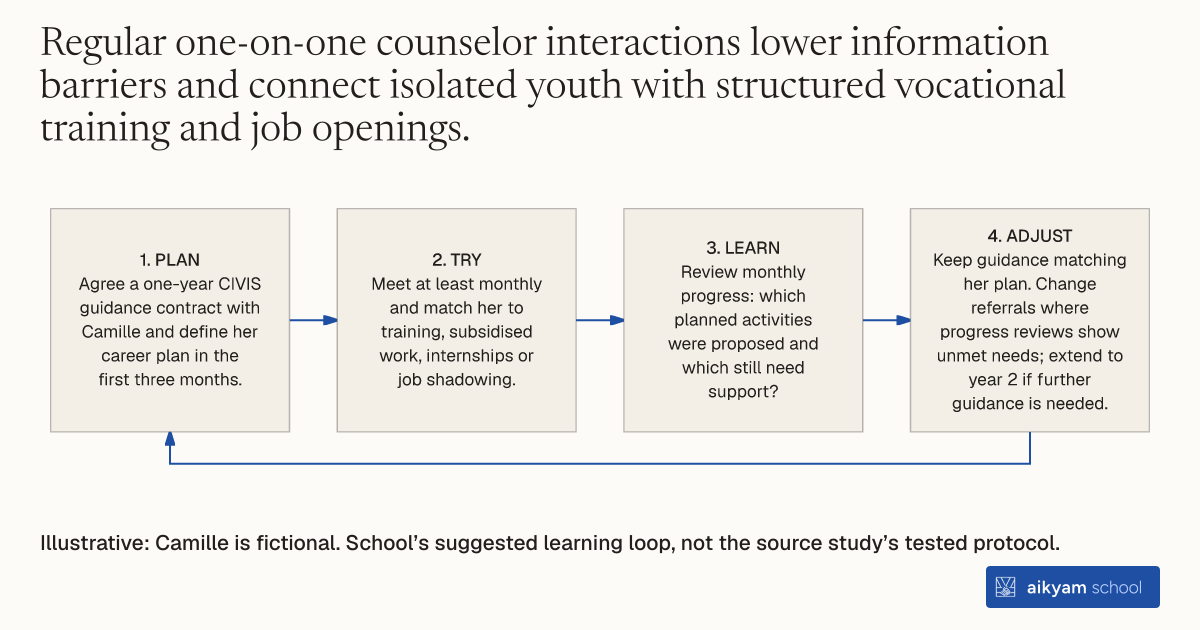
Try, learn and adjust
Check monthly guidance follows the career plan
- Plan: Agree a one-year CIVIS guidance contract with Camille and define her career plan in the first three months.
- Try: Meet at least monthly and match her to training, subsidised work, internships or job shadowing.
- Learn: Review monthly progress: which planned activities were proposed and which still need support?
- Adjust: Keep guidance matching her plan. Change referrals where progress reviews show unmet needs; extend to year 2 if further guidance is needed.
Illustrative: Camille is fictional. School’s suggested learning loop, not the source study’s tested protocol.
See source →School’s suggested, untested loop. Observe meetings, the career plan, referrals and progress. Guidance is not an employment guarantee.
How
When to use
Many young dropouts leave school without qualifications and lack basic labor market knowledge. Public employment agencies provide structured counseling contracts to help these youth set career plans and access vocational opportunities. This method delivers personalized career guidance and service matching to unskilled young jobseekers.
Deliver one-to-two-year individualized career counseling contracts to low-qualified youth through local employment centers.
- Counselors formalize a one-year agreement with registered jobseekers, setting mutual commitment terms.
- Counselors conduct mandatory individual meetings with jobseekers at least once a month, supplementing exchanges via phone and email.
- Counselors work with participants during the first three months to define a tailored career plan based on individual skills.
- Counselors steer jobseekers toward external vocational training courses, subsidized job contracts, internships, or company job shadowing.
- Counselors review participant progress during monthly meetings and extend the program contract for a second year if further guidance is needed.
Why it works
Providing a continuous institutional contact point helps low-skilled jobseekers navigate complex labor market entry steps.
Example
In France, 2,837 young jobseekers assigned to the standard CIVIS guidance program across 82 Job Youth Centers received an average of 7.3 counselor meetings over 11.4 months in the program, with 27% exiting into long-term employment, 15% completing two full years, and 58% dropping out or losing contact.
About the study
Participants
2,837 young unskilled jobseekers aged 18–22 assigned to the control group across 82 Job Youth Centers in France, where 63.7% lacked a high school diploma.
Study Design
Randomized controlled trial tracking administrative and survey outcomes over 24 months for jobseekers receiving standard CIVIS guidance without cash transfers.
Results
Participants in the standard guidance control group averaged 11.4 months of enrollment, 7.3 counselor meetings, €237 in search cost reimbursements, and an overall 24-month employment volume mean of 5.23 months.