Try, learn and adjust
Check support for driving credentials
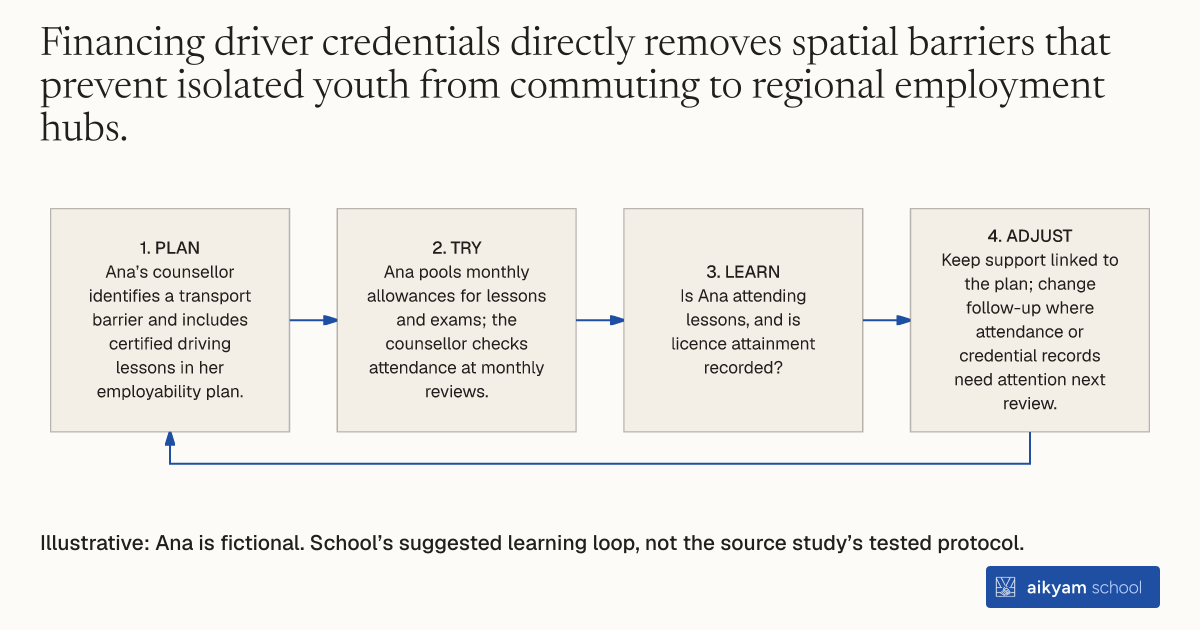
- Plan: Ana’s counsellor identifies a transport barrier and includes certified driving lessons in her employability plan.
- Try: Ana pools monthly allowances for lessons and exams; the counsellor checks attendance at monthly reviews.
- Learn: Is Ana attending lessons, and is licence attainment recorded?
- Adjust: Keep support linked to the plan; change follow-up where attendance or credential records need attention next review.
Illustrative: Ana is fictional. School’s suggested learning loop, not the source study’s tested protocol.
See source →School’s suggested learning loop, not a tested source procedure. Observe lesson attendance and recorded licence attainment; this does not establish an employment effect.
How
When to use
Many low-income young jobseekers living in underprivileged areas face geographic mobility barriers when seeking employment in industrial zones poorly served by public transit. Standard vocational training options do not address basic transport bottlenecks, while obtaining a driver's license requires high upfront cash outlays that disadvantaged youth cannot afford. This method provides targeted financial assistance within youth guidance contracts to enable participants to pay for driving lessons and obtain driver credentials.
Finance driving instruction fees and license exams through flexible transfer allowances within youth career guidance programs.
- Counselors identify jobseekers who face transport barriers and lack a valid driver's license during initial career planning sessions.
- Counselors recommend enrollment in certified driving schools as part of the participant's tailored employability plan.
- Program systems disburse monthly cash allowances that jobseekers pool to cover recurring driving instruction and exam fees.
- Counselors verify participant attendance at driving lessons during monthly progress review meetings.
- Program staff record driving license attainment in administrative databases to confirm transport readiness for local job openings.
Why it works
Accumulating funds through regular allowances enables jobseekers to clear high upfront license fees that otherwise block labor market access.
Example
In France, 2,661 young jobseekers receiving monthly cash transfers through Job Youth Centers increased driver's license course enrollment by 3.0 percentage points at 12 months, raising automobile usage for job search to 55.4% at 24 months.
About the study
Participants
2,661 young jobseekers assigned to cash transfers and 2,837 control participants across 82 Job Youth Centers in France, where 63.7% lacked a high school diploma.
Study Design
Randomized controlled trial tracking specific human capital investment components and mobility indicators via 12-month midline and 24-month endline phone surveys.
Results
Cash transfers increased the proportion of jobseekers starting driver's license courses by 3.0 percentage points (ITT, p < 0.05) from a control mean of 41.9% at 12 months, with car usage rising significantly to 55.4% at 24 months (p < 0.05).