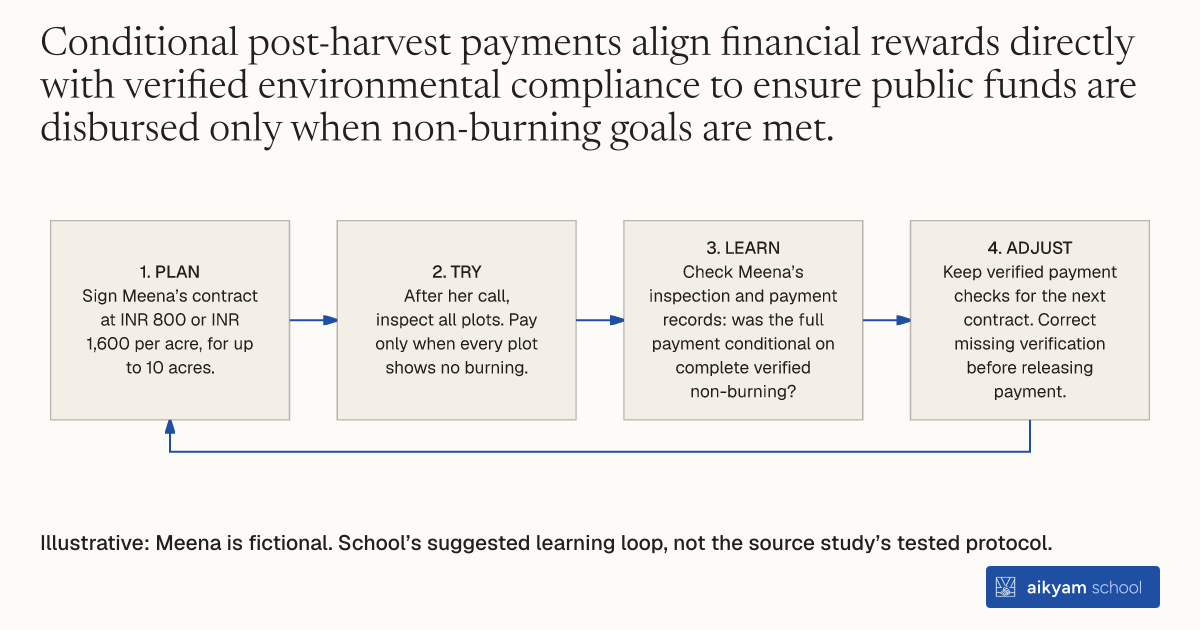
Try, learn and adjust
Check non-burning before post-harvest payment
- Plan: Sign Meena’s contract at INR 800 or INR 1,600 per acre, for up to 10 acres.
- Try: After her call, inspect all plots. Pay only when every plot shows no burning.
- Learn: Check Meena’s inspection and payment records: was the full payment conditional on complete verified non-burning?
- Adjust: Keep verified payment checks for the next contract. Correct missing verification before releasing payment.
Illustrative: Meena is fictional. School’s suggested learning loop, not the source study’s tested protocol.
See source →School’s suggested, untested loop. Observe all-plot compliance and payment; standard payments showed no statistically significant burning reduction.
How
When to use
Programs incentivizing environmental conservation often disburse rewards only after participants complete compliance tasks and pass verification checks. Low-income agricultural producers faced with upfront mechanical field-clearing costs frequently fail to comply under deferred payment structures. This method structures payments as purely post-verification rewards delivered after harvest.
Offer farmers a conditional financial reward disbursed only after post-harvest verification confirms complete non-burning of paddy fields.
- Sign a conditional non-burning agreement with eligible paddy farmers before harvest.
- Specify a payment rate of INR 800 (US $9.93) or INR 1,600 (US $19.86) per acre for up to 10 acres.
- Require enrolled farmers to call the project team once stubble management is complete.
- Dispatch verification teams to inspect all plots in person for physical signs of stubble burning.
- Disburse the full conditional cash transfer only if all inspected plots show no signs of burning.
Example
In Punjab, India, researchers offered farmers in 58 villages standard post-harvest PES contracts paying INR 800 or INR 1,600 per acre upon verified non-burning. Although approximately 72% of farmers signed contracts, only 8.5% complied and requested verification, resulting in no statistically significant reduction in burning relative to the 90.1% control burn rate.
About the study
Participants
Farmers in 58 villages (30 villages offered INR 800/acre; 28 villages offered INR 1,600/acre) out of 1,668 enrolled farmers across Bathinda and Faridkot, Punjab, India.
Study Design
Randomized Controlled Trial comparing standard post-harvest PES arms against an unrewarded comparison group and up-front advance payment arms.
Results
Standard post-harvest PES resulted in an average compliance rate of 8.5%, and satellite remote sensing confirmed that farmers offered standard PES were just as likely as the comparison group to burn residue (where 90.1% burned).