Try, learn and adjust
Check upfront conservation payments and verification
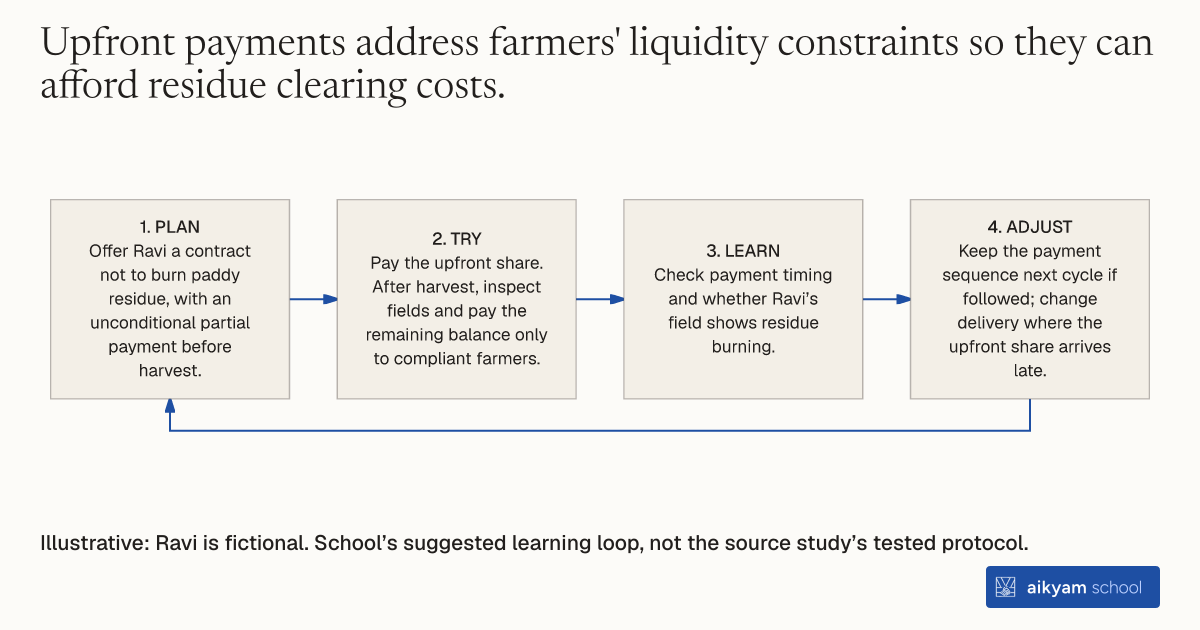
- Plan: Offer Ravi a contract not to burn paddy residue, with an unconditional partial payment before harvest.
- Try: Pay the upfront share. After harvest, inspect fields and pay the remaining balance only to compliant farmers.
- Learn: Check payment timing and whether Ravi’s field shows residue burning.
- Adjust: Keep the payment sequence next cycle if followed; change delivery where the upfront share arrives late.
Illustrative: Ravi is fictional. School’s suggested learning loop, not the source study’s tested protocol.
See source →School’s suggested learning loop; not a tested source procedure. Observe upfront receipt, post-harvest compliance and conditional final payment; do not assume the illustrative loop establishes impact.
How
When to use
Smallholder farmers in agricultural regions burn crop residue after harvest, causing severe seasonal air pollution. Standard conservation contracts pay farmers only after compliance is verified, which fails because farmers face liquidity constraints and distrust that funders will pay. This method applies to environmental program officers seeking to stop crop residue burning among credit-constrained smallholders.
Structure payments for ecosystem services contracts to include an unconditional upfront cash transfer before verification.
- Program administrators identify smallholder farmers who cultivate paddy fields in targeted agricultural regions.
- Program administrators offer farmers payments for ecosystem services contracts conditional on not burning crop residue after harvest.
- Program administrators disburse a partial unconditional monetary transfer upfront before harvesting begins.
- Farmers use the upfront cash to cover clearing equipment and labor expenses without burning residue.
- Verification teams inspect paddy fields after harvest to check compliance.
- Program administrators disburse the remaining conditional payment balance to compliant farmers in Punjab, India.
Why it works
Receiving money upfront builds institutional trust that final payments will be made upon compliance.
Example
In Punjab, India, researchers offered farmers partial upfront payments to not burn paddy residue, which increased contract compliance and reduced crop burning compared to post-verification contracts, despite offering a lower total transfer.
About the study
Participants
Smallholder agricultural farmers in Punjab, India.
Study Design
Randomized controlled trial evaluating payments for ecosystem services contracts varying payment timing and amounts.
Results
Farmers offered partial upfront, unconditional payments were more likely to comply with contract conditions and reduce crop residue burning than farmers offered standard post-verification contracts, despite receiving a lower total monetary transfer.