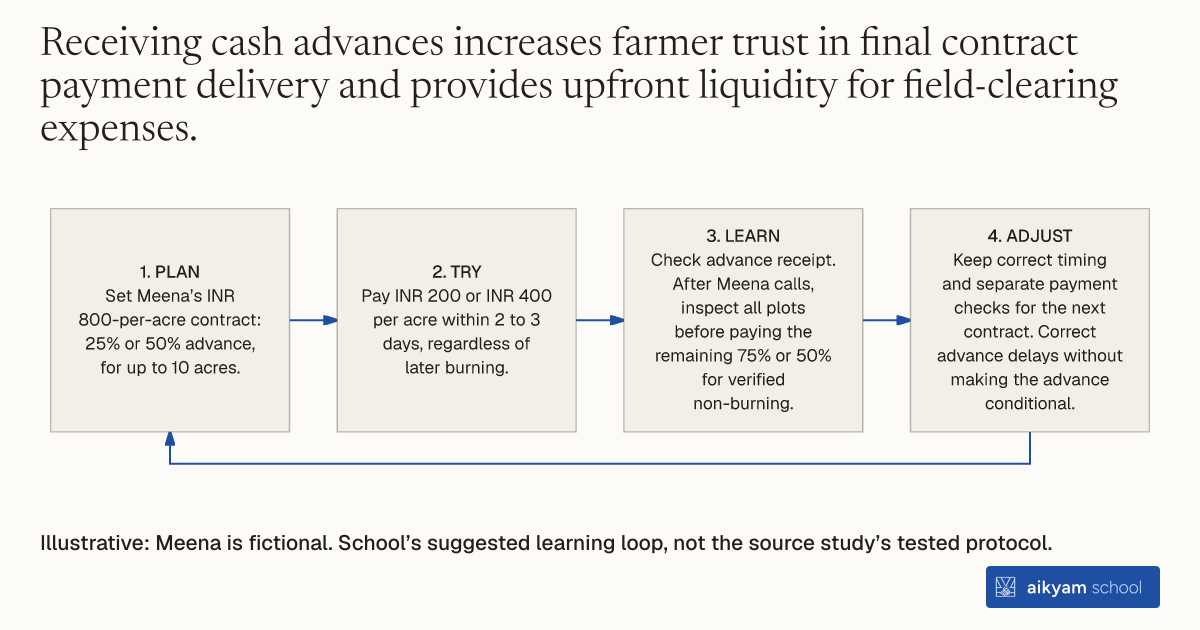
Try, learn and adjust
Check unconditional advances and conditional balances
- Plan: Set Meena’s INR 800-per-acre contract: 25% or 50% advance, for up to 10 acres.
- Try: Pay INR 200 or INR 400 per acre within 2 to 3 days, regardless of later burning.
- Learn: Check advance receipt. After Meena calls, inspect all plots before paying the remaining 75% or 50% for verified non-burning.
- Adjust: Keep correct timing and separate payment checks for the next contract. Correct advance delays without making the advance conditional.
Illustrative: Meena is fictional. School’s suggested learning loop, not the source study’s tested protocol.
See source →School’s suggested, untested loop. Observe advance timing and verified compliance for the balance; do not change assigned advance rates.
How
When to use
Low-income agricultural producers face liquidity constraints and low trust in deferred payment offers when asked to adopt clean field-clearing alternatives. Standard post-harvest compensation fails to provide the immediate cash needed for machinery rentals before harvest. This payment method offers farmers an unconditional advance shortly after contract signing to increase trust and provide early liquidity.
Disburse an unconditional cash advance to farmers shortly after signing an environmental service agreement before harvest begins.
- Offer paddy farmers managing 2 to 12 acres an agreement paying a total rate of INR 800 per acre.
- Provide an advance of 25 percent (INR 200 per acre) or 50 percent (INR 400 per acre) for up to 10 acres.
- Disburse the advance within 2 to 3 days of contract signing regardless of future burning decisions.
- Require farmers to notify the project team once harvest and field clearing are complete.
- Inspect fields in person to confirm that stubble was not burned.
- Disburse the remaining 75 percent or 50 percent payment upon verified non-burning compliance.
Why it works
This early cash disbursal overcomes credit barriers during tight harvesting windows.
Example
Researchers offered farmers in 62 villages in Punjab, India an upfront advance of 25 percent or 50 percent on INR 800 per acre non-burning contracts. Farmers receiving upfront payments were 10 percentage points more likely to comply than those under standard PES, reducing satellite-detected stubble burning by 7.7 percentage points compared to comparison villages.
About the study
Participants
Farmers across 62 villages (31 villages with 25 percent advance; 31 villages with 50 percent advance) out of 1,668 enrolled farmers in Bathinda and Faridkot, Punjab, India.
Study Design
Randomized Controlled Trial comparing 25 percent and 50 percent unconditional up-front PES advances against standard post-harvest PES and unrewarded comparison villages.
Results
Up-front PES increased contract compliance by 10 percentage points above the 8.5 percent compliance rate in standard PES. Satellite remote sensing confirmed a 7.7 percentage point reduction in residue burning compared to the comparison group where 90.1 percent burned, while increasing trust in final payment delivery from 85.4 percent to 92.2 percent.