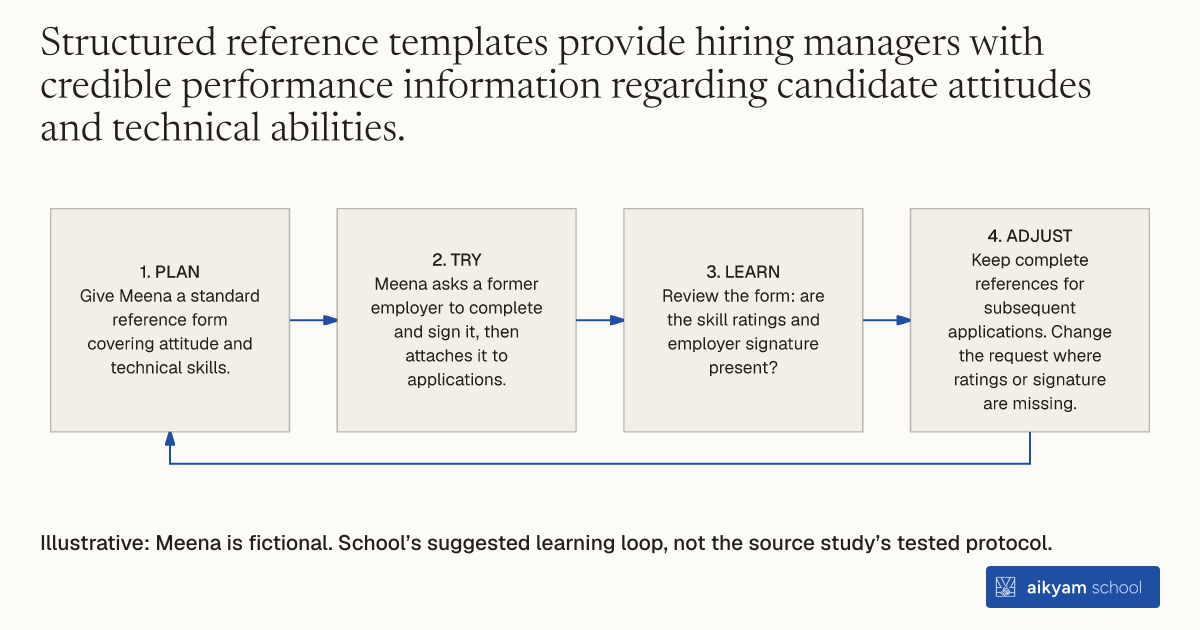
Try, learn and adjust
Check references include employer assessments
- Plan: Give Meena a standard reference form covering attitude and technical skills.
- Try: Meena asks a former employer to complete and sign it, then attaches it to applications.
- Learn: Review the form: are the skill ratings and employer signature present?
- Adjust: Keep complete references for subsequent applications. Change the request where ratings or signature are missing.
Illustrative: Meena is fictional. School’s suggested learning loop, not the source study’s tested protocol.
See source →School’s suggested, untested loop. Observe completed references and their use in applications. No interview or employment result is assumed.
How
When to use
Job seekers and female workers in entry-level labor markets lack verifiable reference letters to showcase their technical skills and workplace attitudes. Hiring managers rely on informal referral networks that exclude disadvantaged candidates. This method enables job seekers to collect structured reference evaluations from former employers.
Distribute standardized reference letter forms to job seekers for former employers to evaluate workplace skills.
- Project staff design a simple reference letter template rating candidate attitude and technical skills.
- Job seekers request former employers to complete and sign the standardized reference template.
- Applicants attach completed reference templates to their job application packages.
- Candidates submit the standardized reference letters to hiring firms during employment searches.
Why it works
This causes employers to review female applications more frequently, respond to positive references, and update their beliefs about women's skills.
Example
In South Africa, job seekers received a reference letter template to ask previous employers to rate their attitude and technical skills. Women who used the reference letters were more likely to receive job interviews and be employed three months later, closing the hiring gender gap within the study population.
About the study
Participants
Human job seekers and former employers in South Africa.
Study Design
Randomized evaluation comparing job seekers offered reference letter templates against a comparison group.
Results
Women using reference letters received more interview invitations and achieved higher employment rates three months later relative to comparison candidates, closing the gender gap in hiring.