Try, learn and adjust
Check workers follow written factory procedures
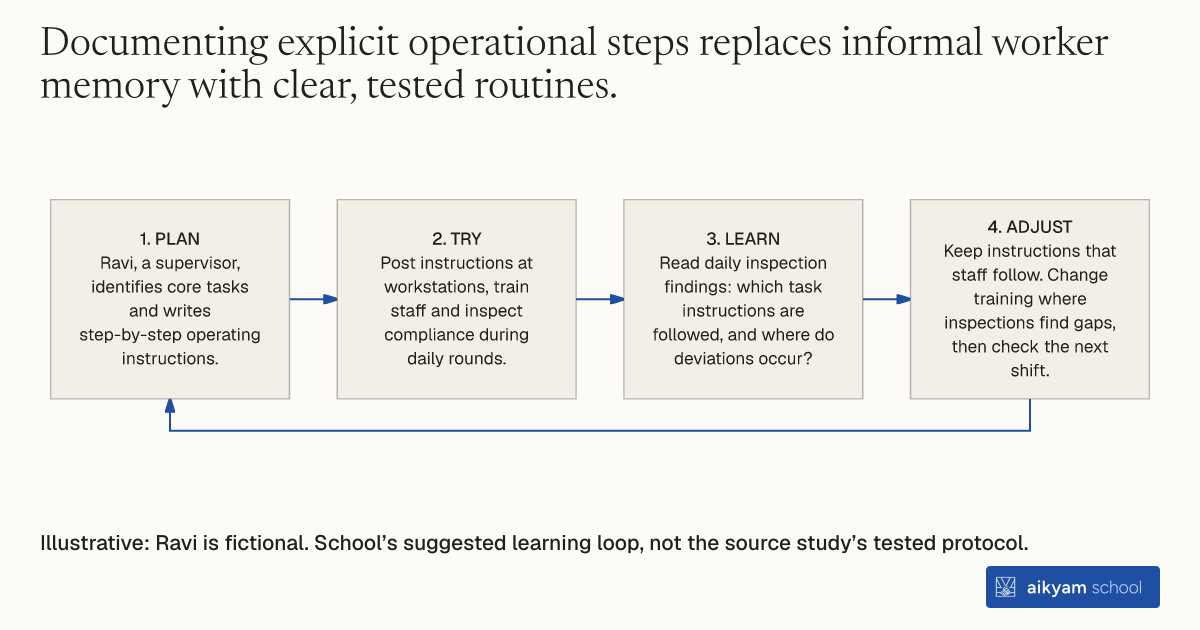
- Plan: Ravi, a supervisor, identifies core tasks and writes step-by-step operating instructions.
- Try: Post instructions at workstations, train staff and inspect compliance during daily rounds.
- Learn: Read daily inspection findings: which task instructions are followed, and where do deviations occur?
- Adjust: Keep instructions that staff follow. Change training where inspections find gaps, then check the next shift.
Illustrative: Ravi is fictional. School’s suggested learning loop, not the source study’s tested protocol.
See source →School's suggested, untested loop: observe posted instructions, training and compliance; no effect on output is assumed.
How
When to use
Complex multi-building manufacturing operations in developing regions often rely on unwritten worker habits rather than documented instructions. This reliance on informal routines creates process variations, inconsistent quality, and frequent worker errors across daily shifts. Implementing standardized operating procedures establishes written, repeatable instructions for core factory tasks.
Document clear standard operating procedures for core factory tasks and train workers to follow consistent production routines.
- Identify essential production tasks, quality checks, and equipment operations across all factory sections.
- Draft written step-by-step operating procedures outlining exact instructions for machine operators.
- Post procedure instructions visibly at relevant work stations and machinery locations across the floor.
- Train plant supervisors and workers on executing standardized instructions consistently during every shift.
- Direct supervisors to inspect worker compliance with operating procedures during daily factory rounds.
Why it works
Standardized instructions reduce process variation and prevent operator errors across factory shifts.
Example
Consultants introduced standardized operating procedures alongside thirty-seven other basic practices across twenty-eight textile plants near Mumbai, India, where managers were previously unaware of formal operating standards.
About the study
Participants
Seventeen large textile manufacturing firms with twenty-eight factory plants near Mumbai, India, averaging 270 employees, US$13 million in assets, and US$7.5 million in annual sales per firm.
Study Design
Randomized controlled trial evaluating an intensive four-month consulting intervention that introduced standardized operating procedures across treatment plants.
Results
Introducing standardized operating procedures and related practices increased plant output by 9.4 percent, total factor productivity by 16.6 percent, and annual profit by an estimated US$325,000 per plant.