Try, learn and adjust
Check fabric prices against design-specific costs
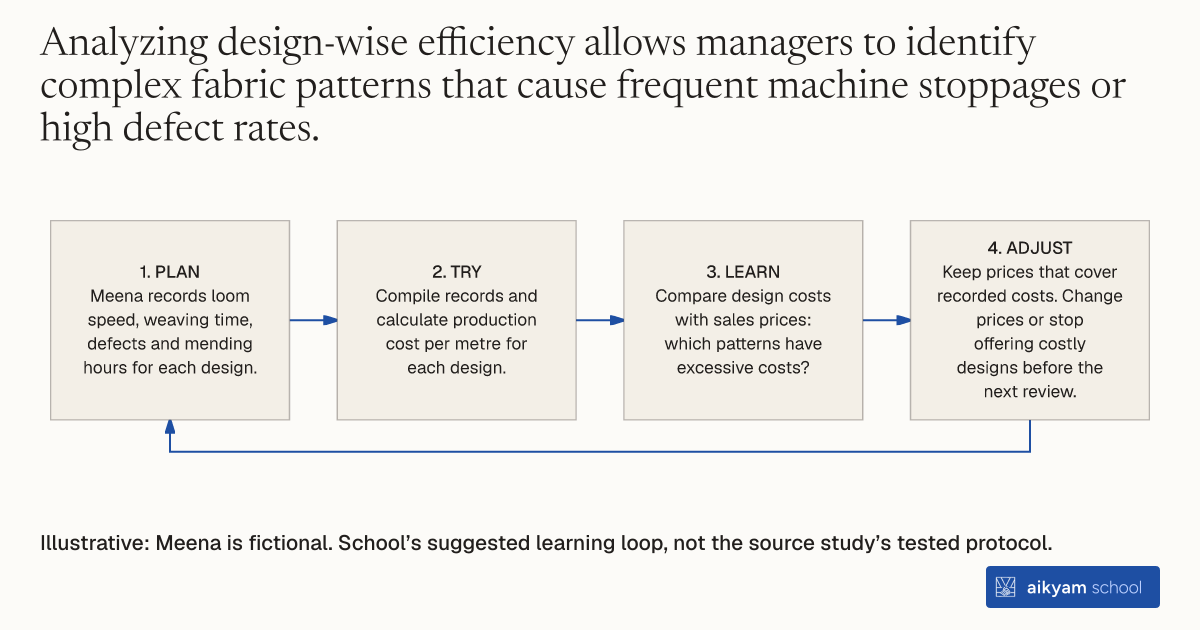
- Plan: Meena records loom speed, weaving time, defects and mending hours for each design.
- Try: Compile records and calculate production cost per metre for each design.
- Learn: Compare design costs with sales prices: which patterns have excessive costs?
- Adjust: Keep prices that cover recorded costs. Change prices or stop offering costly designs before the next review.
Illustrative: Meena is fictional. School’s suggested learning loop, not the source study’s tested protocol.
See source →Observe design-specific production costs, defects and prices. School suggests this learning loop; it is not the source’s tested procedure.
How
When to use
Textile factories often set sales prices based on factory-wide average production costs rather than the actual labor and machine hours required for each fabric design. As a result, plants underprice complex fabric patterns that generate high defect rates and overprice simple, profitable fabric designs. This method helps factory directors analyze historical loom efficiency data by design to price products accurately and drop unprofitable patterns from sales catalogs.
Analyze historical efficiency data by fabric design to base product pricing on actual production costs and eliminate unprofitable designs from factory catalogs.
- Machine operators log loom production speed, thread breakages, and weaving time for every fabric design daily.
- Quality checkers record defect rates and mending hours associated with each specific fabric pattern.
- Operations staff compile historical loom efficiency and defect records for each design into centralized tracking databases.
- Production managers calculate actual production costs per meter for individual fabric designs using recorded efficiency data.
- Firm owners set customer sales prices based on actual design-wise production costs rather than factory-wide average costs.
- Sales managers drop error-prone, complex fabric designs with excessive production costs from the product catalog.
Why it works
Pricing products based on actual production costs ensures the firm covers design-specific labor and scrap expenses while dropping unprofitable lines.
Example
International consultants guided directors at woven cotton textile plants near Mumbai, India to analyze historical efficiency data by design, enabling owners to adjust pricing and drop defect-heavy fabric patterns from sales catalogs.
About the study
Participants
28 plants across 17 large, family-owned cotton textile weaving firms in Tarapur and Umbergaon near Mumbai, India, averaging 273 employees and \$7.45 million in annual sales per firm.
Study Design
Randomized controlled trial providing 11 treatment firms with 5 months of management consulting and 6 control firms with 1 month of diagnostic consulting, tracking weekly data across ~100 weeks.
Results
Adopting design-wise efficiency analysis alongside other lean manufacturing practices helped increase factory output by 9.4% (p = 0.026) and total factor productivity by 16.6% (p = 0.061), while baseline adoption of design-wise efficiency analysis was 0% in both treatment and control plants.