Research procedure
Keep assessment delivery and marking secure
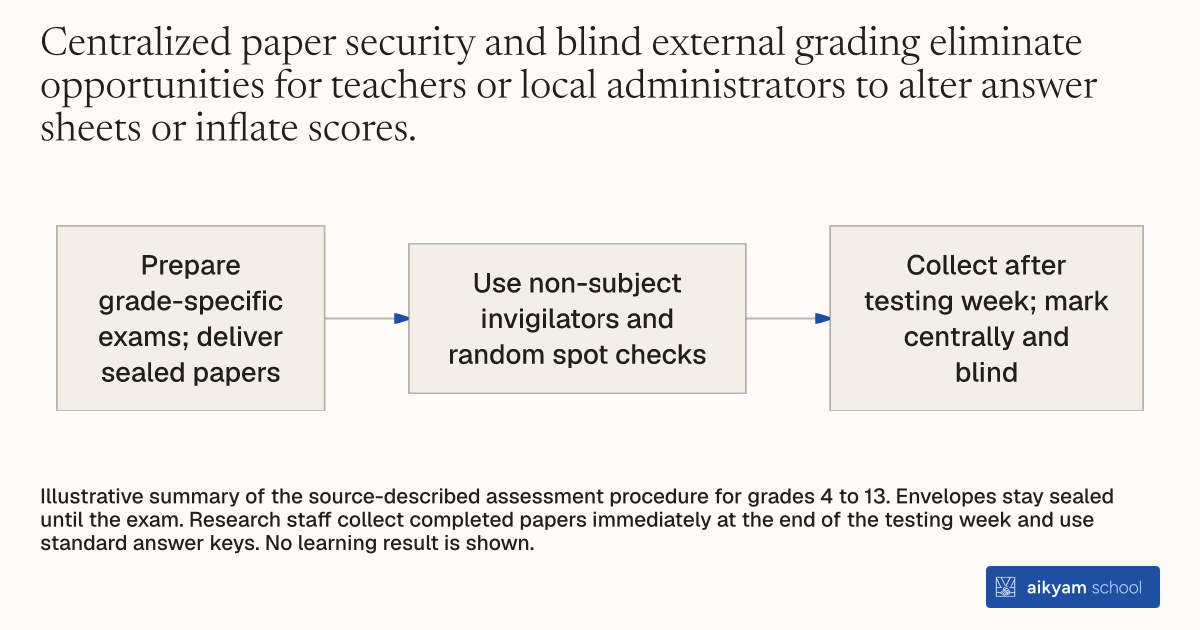
- Prepare grade-specific exams; deliver sealed papers
- Use non-subject invigilators and random spot checks
- Collect after testing week; mark centrally and blind
Illustrative summary of the source-described assessment procedure for grades 4 to 13. Envelopes stay sealed until the exam. Research staff collect completed papers immediately at the end of the testing week and use standard answer keys. No learning result is shown.
See source →How
When to use
School systems evaluating teacher performance pay schemes need unbiased measures of student academic achievement across core subjects. School-administered or teacher-graded tests introduce risks of cheating, inflated marks, or inconsistent grading standards across campuses. This method provides educational managers with a tamper-resistant, centrally administered and blind-graded testing protocol to measure true learning gains.
Administer standardized core-subject academic assessments using secure delivery protocols and centralized research grading to prevent test inflation or proctoring bias.
- Develop grade-specific exam papers combining curriculum-aligned questions with international benchmark items across core subjects in grades 4 to 13.
- Deliver printed exam papers to participating schools in sealed envelopes that remain sealed until official exam administration times.
- Require non-subject home-room teachers to proctor student exams while external research enumerators perform random unannounced classroom spot checks.
- Collect all completed exam booklets immediately at the end of the testing week without leaving materials with school staff.
- Grade all student exam papers at a central research office using standardized answer keys and blinded review procedures.
Why it works
Non-subject proctoring and unannounced spot checks prevent classroom cheating while preserving testing integrity.
Example
A private school network in Pakistan assessed endline student learning across Reading, Math, Science, and Economics for 48,148 students in grades 4 to 13. Sealed test envelopes were proctored by non-subject teachers with spot-check monitoring, and research staff collected and centrally graded all booklets. The assessment protocol enabled precise measurement of a 0.09 standard deviation increase in student test scores under objective performance pay.
About the study
Participants
48,148 students in grades 4 through 13 tested across participating private schools in Pakistan.
Study Design
Standardized endline exam administration and centralized grading embedded in a school-level randomized controlled trial, with 13 percent overall student attrition (3 percent absent, 10 percent parental opt-out).
Results
Centralized testing revealed an average 0.09 standard deviation increase in endline test scores for teachers assigned to objective performance pay who chose performance contracts, with zero reported instances of proctoring violations during spot checks.