Research assessment
Test producers under identical conditions
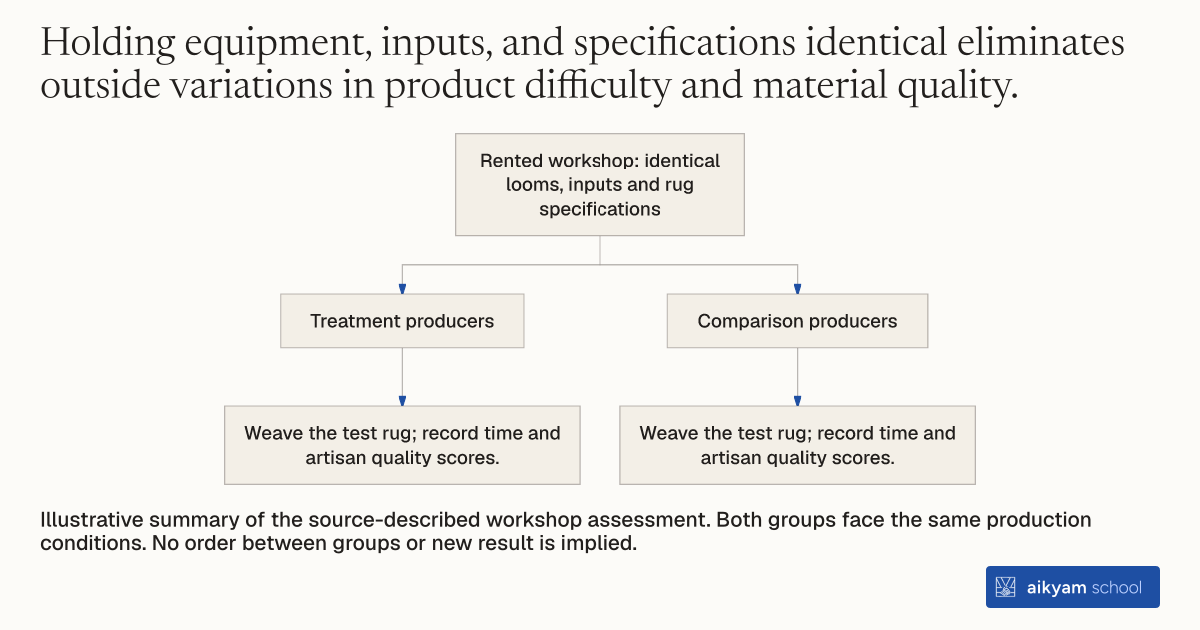
Rented workshop: identical looms, inputs and rug specifications
- Treatment producers
- Weave the test rug; record time and artisan quality scores.
- Comparison producers
- Weave the test rug; record time and artisan quality scores.
Illustrative summary of the source-described workshop assessment. Both groups face the same production conditions. No order between groups or new result is implied.
See source →How
When to use
Measuring true changes in manufacturing efficiency in field settings is hard because product specifications vary between producers. Development researchers need a way to isolate pure skill improvements from differences in raw materials, looms, or design difficulty. This approach tests treatment and control producers inside a standardized rented workshop under identical working conditions.
Evaluate producer skill and efficiency gains by testing subject performance in a standardized lab workshop with identical equipment and inputs.
- Evaluator rents a central workshop location to serve as a standardized quality lab.
- Evaluator provides identical looms, warp threads, weft threads, and design specifications to all tested producers.
- Evaluator brings treatment and comparison firm owners into the workshop to produce identical test rugs.
- Evaluator measures the exact time spent by each producer to complete the test rug.
- Evaluator scores completed test rugs across standard physical quality dimensions using master artisans.
Why it works
It allows evaluators to isolate and measure true gains in producer technique, speed, and overall skill.
Example
Researchers brought rug producers in Fowa, Egypt, into a rented workshop to weave identical rugs on identical looms with identical inputs, observing that exporting producers wove faster and achieved higher quality scores.
About the study
Participants
N = 219 eligible small rug producers (74 treatment, 145 comparison) with fewer than 5 employees in Fowa, Egypt.
Study Design
Controlled experimental task in a neutral rented workshop evaluating 74 treatment and 145 comparison firm owners on identical rug specifications.
Results
When tested on identical looms and specifications, exporting firms produced rugs faster and achieved higher quality scores than comparison firms.