Research design
Monitor retail study activities together
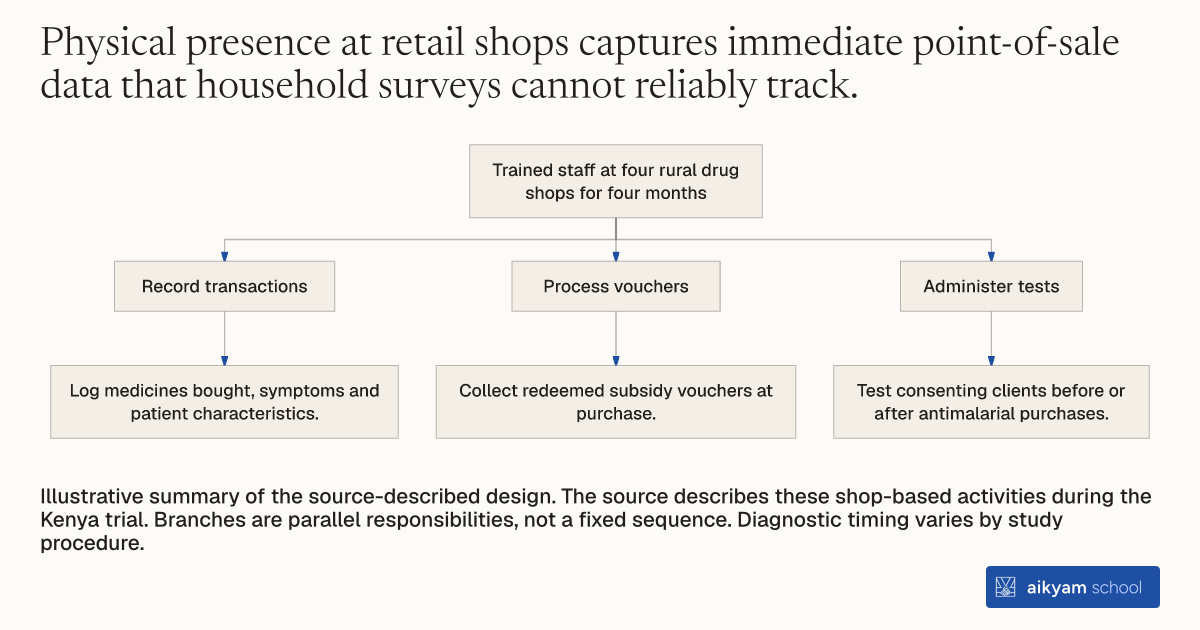
Trained staff at four rural drug shops for four months
- Record transactions
- Log medicines bought, symptoms and patient characteristics.
- Process vouchers
- Collect redeemed subsidy vouchers at purchase.
- Administer tests
- Test consenting clients before or after antimalarial purchases.
Illustrative summary of the source-described design. The source describes these shop-based activities during the Kenya trial. Branches are parallel responsibilities, not a fixed sequence. Diagnostic timing varies by study procedure.
See source →How
When to use
Private retail drug shops often lack medical staff and standardized transaction records. Placing qualified staff directly at retail shops enables accurate transaction tracking, patient symptom logging, and on-site diagnostic testing. This method helps health evaluators gather reliable real-time sales and patient data from informal retail markets.
Station qualified field staff at participating retail drug shops to record transactions and administer diagnostic tests.
- Program managers recruit and train field staff in research protocols, diagnostic testing, and detailed record keeping.
- Field staff post themselves at participating private drug shops during daily operating hours for four months.
- Staff record details of all transactions, including medicines bought, symptoms, and patient characteristics.
- Staff process customer subsidy vouchers and collect redeemed discount vouchers at the point of purchase.
- Trained technicians perform rapid diagnostic tests on consenting clients before or after antimalarial purchases.
Why it works
Direct staff oversight ensures that diagnostic tests and drug subsidies follow protocol without relying on shopkeeper reporting.
Example
In western Kenya, researchers posted trained study staff at four rural drug shops between May and December 2009. Over four months, these staff recorded every subsidy transaction, logged patient symptoms, and administered on-site rapid diagnostic tests. Their continuous presence enabled full transaction monitoring across 2,789 households and confirmed that 51 percent of test-negative adults declined antimalarials.
About the study
Participants
2,789 households residing near four rural drug shops in western Kenya, with 38 percent of household heads illiterate.
Study Design
Randomized controlled trial conducted from May to December 2009 where trained study staff were posted at four participating private drug shops for four months. Staff processed voucher redemptions, recorded transaction and patient details, administered rapid diagnostic tests, and audited retail medication purchases.
Results
Stationed staff successfully tracked transactions across four months for 2,789 households. They administered rapid diagnostic tests that increased overall testing rates from 22 percent to 43 percent, showing that 82 percent of children buying subsidized ACTs had true malaria compared to 25 percent of adults.