Research procedure
Verify bednet use at home
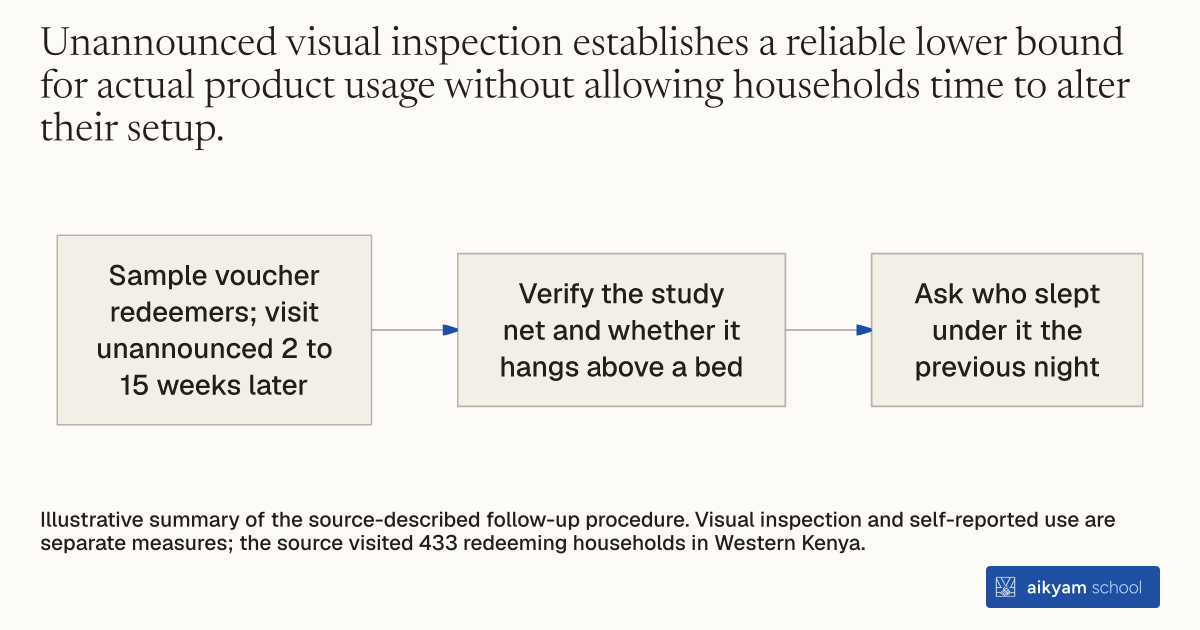
- Sample voucher redeemers; visit unannounced 2 to 15 weeks later
- Verify the study net and whether it hangs above a bed
- Ask who slept under it the previous night
Illustrative summary of the source-described follow-up procedure. Visual inspection and self-reported use are separate measures; the source visited 433 redeeming households in Western Kenya.
See source →How
When to use
Rural health programs often rely on self-reported data to evaluate whether households actually use subsidized preventive health products like long-lasting bednets. Self-reports tend to overstate true compliance due to social desirability bias. Conducting unannounced home visits provides an objective physical verification of product usage among redeeming households.
Verify health product usage objectively by conducting unannounced follow-up visits to homes after discount voucher redemption.
- Sample households that redeemed vouchers for long-lasting insecticide-treated bednets at participating local retail shops.
- Schedule field enumerators to visit selected homes unannounced 2 to 15 weeks after voucher redemption.
- Request to see the distributed bednet inside the home and verify that it matches the study-supplied product.
- Record whether the bednet is visually observed hanging above a sleeping bed.
- Survey household members regarding who slept under the net during the preceding night.
Why it works
Physical verification eliminates self-reporting bias and confirms whether acquired health items are retained and actively installed.
Example
Field enumerators in Western Kenya conducted unannounced follow-up visits 2 to 15 weeks after voucher redemption to 433 households that purchased bednets, verifying retention and inspecting whether nets were hanging above beds.
About the study
Participants
Subsample of 433 households that redeemed vouchers in Western Kenya out of 1,289 enrolled households averaging 7.43 members.
Study Design
Follow-up survey conducted during unannounced visits 2 to 15 weeks after voucher redemption (1 to 5 months after baseline) to inspect bednets visually, verify study net ownership, and record self-reported usage for the preceding night.
Results
Enumerators observed the study net hanging above a bed in 57.7 percent of visited households, while 64.7 percent self-reported using the net and 95 percent retained the net in their home. Bednet usage was not significantly higher in higher price groups or under any marketing or targeting treatment.