Research steps
Elicit conditional patient complaints
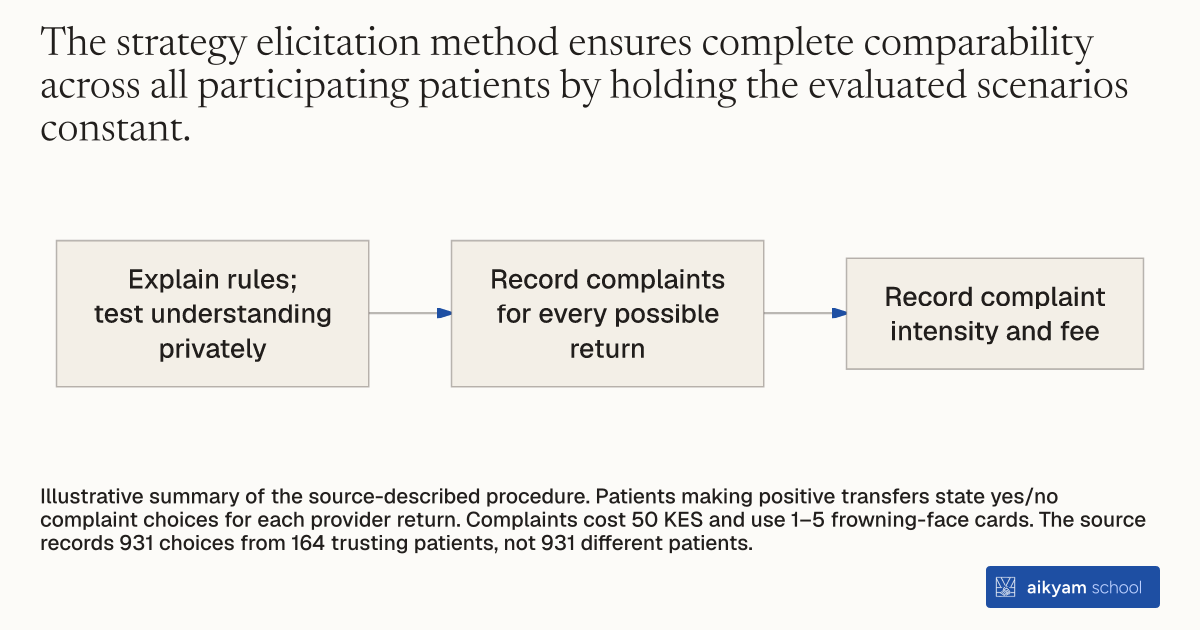
- Explain rules; test understanding privately
- Record complaints for every possible return
- Record complaint intensity and fee
Illustrative summary of the source-described procedure. Patients making positive transfers state yes/no complaint choices for each provider return. Complaints cost 50 KES and use 1–5 frowning-face cards. The source records 931 choices from 164 trusting patients, not 931 different patients.
See source →How
When to use
Evaluating citizen willingness to use public reporting systems against health providers requires observing decisions across many potential service outcomes. Directly observing actual return scenarios yields uneven, unstandardized data across participants. This method uses strategy-elicited conditional choices to measure patient reporting preferences systematically across all potential provider return amounts.
Measure patient willingness to report underperforming service providers by registering conditional complaint decisions across every potential return scenario using one-to-one strategy interviews.
- Read game rules and scripted examples aloud to participating patients seated in a separate room from health providers.
- Conduct individual one-to-one interviews with each patient to test comprehension and register initial transfer decisions.
- Present patients who sent positive amounts with a decision form listing every possible amount the matched provider could return.
- Require the patient to state binary yes or no complaint choices for each potential returned amount.
- Ask complaining patients to specify grievance intensity by choosing to send between 1 and 5 frowning face cards after paying a 50 KES fee.
Why it works
It avoids data loss and imbalance that occur when eliciting direct responses to single, non-randomized provider transfers.
Example
In Nairobi, Kenya, researchers interviewed 164 trusting patients across 24 workshops using strategy elicitation forms. Across all return scenarios, patients made binary reporting choices and card intensity decisions, generating 931 discrete complaint choices for econometric analysis.
About the study
Participants
164 trusting patients (out of 216 total patients) recruited from 93 health facilities in Nairobi, Kenya.
Study Design
One-to-one strategy elicitation interviews held during lab-in-the-field workshops measuring binary complaint decisions and complaint card counts across discrete provider return ranges.
Results
Strategy elicitation revealed that tangible accountability mechanisms reduced the extensive margin probability of filing a complaint by 7.4 to 10.3 percentage points while increasing the intensive margin severity by 0.771 to 1.053 cards sent per complaint.