Research procedure
Assign communities within branch strata
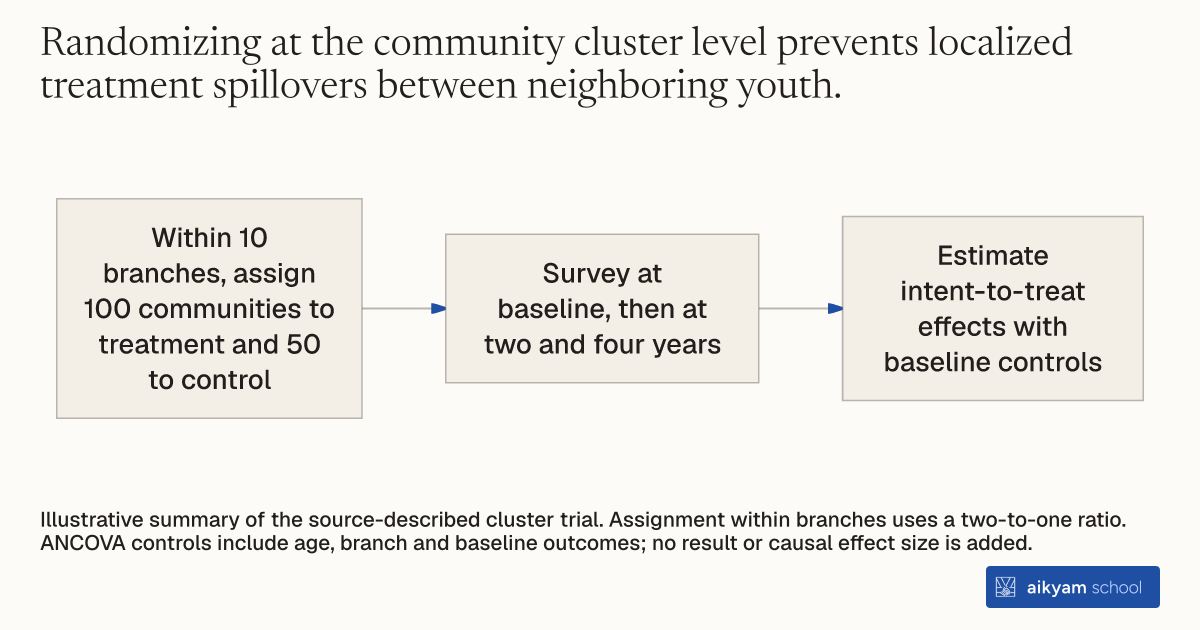
- Within 10 branches, assign 100 communities to treatment and 50 to control
- Survey at baseline, then at two and four years
- Estimate intent-to-treat effects with baseline controls
Illustrative summary of the source-described cluster trial. Assignment within branches uses a two-to-one ratio. ANCOVA controls include age, branch and baseline outcomes; no result or causal effect size is added.
See source →How
When to use
Developing country empowerment programs often lack rigorous impact evaluations, making it hard to separate real intervention effects from broader social changes. Non-randomized designs can suffer from selection bias and unobserved confounding factors. Implement a stratified cluster-randomized trial across administrative branches to evaluate long-term program impacts on youth economic and social outcomes.
Evaluate community-level program impacts using a stratified cluster-randomized control trial tracking baseline, two-year, and four-year outcomes.
- Select representative branch offices across urban, semi-urban, and rural areas.
- Identify communities in each branch office that meet criteria to host a youth program.
- Assign communities within each branch stratum in a two-to-one ratio to treatment or control status.
- Survey a representative random sample of eligible youth at baseline before program rollout.
- Conduct follow-up tracking surveys at two years and four years post-intervention.
- Estimate intent-to-treat effects using ANCOVA regressions controlling for baseline age, branch fixed effects, and baseline outcome values.
Why it works
Stratifying by regional branches balances geographical and socio-economic conditions across intervention arms.
Example
Researchers evaluated BRAC's adolescent empowerment intervention across 10 branch offices in Uganda. They randomly assigned 150 communities (100 treatment, 50 control) stratified by branch, tracking baseline outcomes for 5,966 adolescent girls, midline outcomes for 4,888 girls, and endline outcomes for 3,522 girls.
About the study
Participants
4,888 adolescent girls tracked at midline and 3,522 at endline across 150 communities in Kampala, Mukono, Iganga, and Jinja, Uganda, with average baseline age of 16.3 years.
Study Design
Cluster randomized control trial across 150 communities (100 treatment, 50 control) stratified by 10 branch offices, evaluating outcomes at baseline, midline (2 years), and endline (4 years) using OLS ANCOVA.
Results
Four years post-intervention, engagement in income-generating activities increased by 48%, self-employment rose by 50%, teen pregnancy fell by 34%, early marriage/cohabitation dropped by 62%, and reporting sex against will decreased by 31%.