Research design
Compare village health promoter coverage
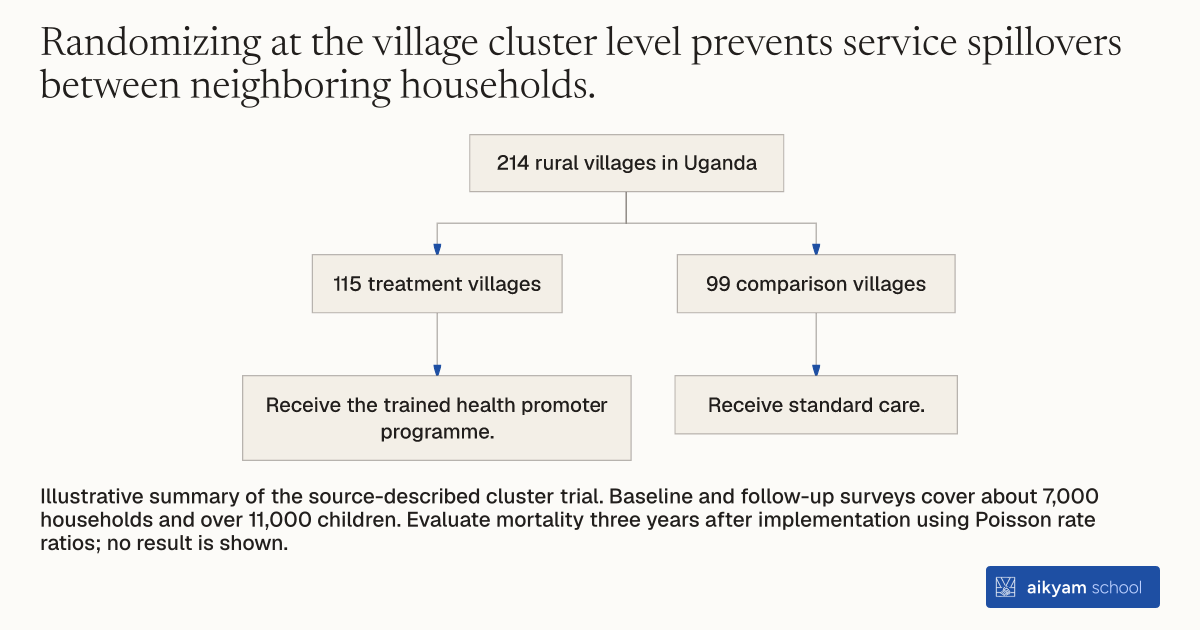
214 rural villages in Uganda
- 115 treatment villages
- Receive the trained health promoter programme.
- 99 comparison villages
- Receive standard care.
Illustrative summary of the source-described cluster trial. Baseline and follow-up surveys cover about 7,000 households and over 11,000 children. Evaluate mortality three years after implementation using Poisson rate ratios; no result is shown.
See source →How
When to use
Evaluating community health programs requires rigorous testing to measure whether social entrepreneurship reduces child mortality. Standard non-randomized comparisons fail to separate program impacts from outside regional health trends. Conducting a cluster randomized controlled trial across treatment and comparison villages provides reliable evidence for health policymakers.
Evaluate a community health promoter initiative using cluster randomization and household follow-up surveys.
- Academic researchers partner with non-governmental health organizations across rural project districts.
- Researchers select target villages and randomly assign them to treatment or comparison status.
- Health organizations deploy trained health promoters to treatment villages while comparison villages receive standard care.
- Survey teams collect baseline and follow-up data from representative households across all study villages.
- Economists estimate relative risk reductions across mortality categories using a Poisson empirical model.
Why it works
Comparing treated villages to comparison villages isolates the true impact of health promoter incentives on child survival.
Example
Researchers randomly assigned 115 villages to the community health promoter program and 99 villages to comparison status in rural Uganda, measuring outcomes across 7,000 households to show a 27 percent drop in child mortality.
About the study
Participants
214 rural villages (115 treatment and 99 comparison villages) covering about 7,000 households and over 11,000 children in Uganda.
Study Design
Cluster randomized controlled trial evaluated three years post-implementation using household surveys and Poisson rate ratio empirical models.
Results
Child mortality dropped by 27 percent (48.5 vs 68.4 deaths per 1,000 births), infant mortality fell by 33 percent (32.4 vs 49.7 per 1,000), and neonatal mortality decreased by 28 percent (24.1 vs 33.4 per 1,000).