Research groups
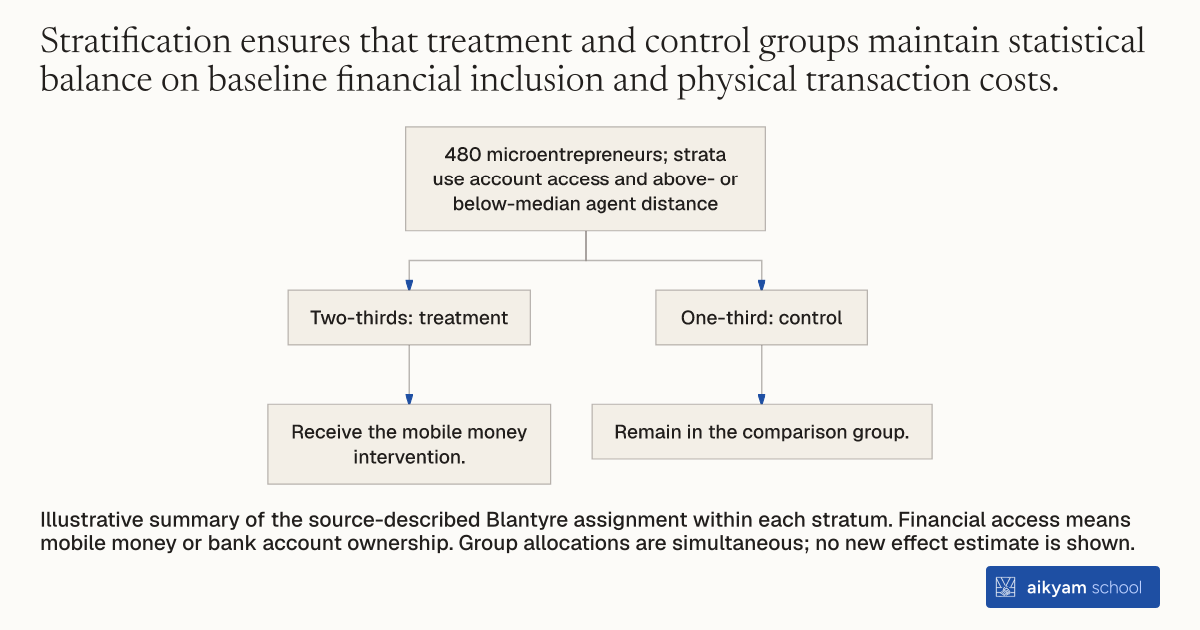
Randomise within financial-access strata
480 microentrepreneurs; strata use account access and above- or below-median agent distance
- Two-thirds: treatment
- Receive the mobile money intervention.
- One-third: control
- Remain in the comparison group.
Illustrative summary of the source-described Blantyre assignment within each stratum. Financial access means mobile money or bank account ownership. Group allocations are simultaneous; no new effect estimate is shown.
See source →How
When to use
Program evaluators need to assign participants to treatment and control groups while ensuring baseline balance across key financial traits. Unstratified assignment risks baseline imbalances in account ownership or physical distance to service agents, which can confound treatment estimates. Stratified randomization balances study arms across baseline financial access and agent proximity for microentrepreneurs in urban markets.
Stratify participant randomization across financial access indicators and geographic proximity metrics to establish balanced study arms.
- Enumerators record baseline financial account access, noting whether respondents own a mobile money account or bank account.
- Enumerators calculate distance from each business location to the nearest mobile money agent and compute the sample median distance.
- Classify respondents into binary strata based on prior account ownership and whether distance to the nearest agent is above or below median.
- Randomly assign two-thirds of respondents within each stratum to receive the mobile money intervention.
- Assign the remaining one-third of respondents within each stratum to the control group.
Why it works
Balancing distance to agents prevents geographic access Frictions from confounding the measured impact of mobile money access.
Example
In Blantyre, Malawi, researchers stratified 480 small-scale entrepreneurs by financial access and agent distance, assigning two-thirds to treatment and one-third to control to evaluate mobile money adoption.
About the study
Participants
480 small-scale microentrepreneurs in Blantyre, Malawi.
Study Design
Randomized controlled trial assigning two-thirds to treatment and one-third to control, stratified by financial account access and agent proximity.
Results
Stratification produced balanced study groups at baseline, enabling clear estimation of a 55% to 80% increase in mobile money deposit likelihood.