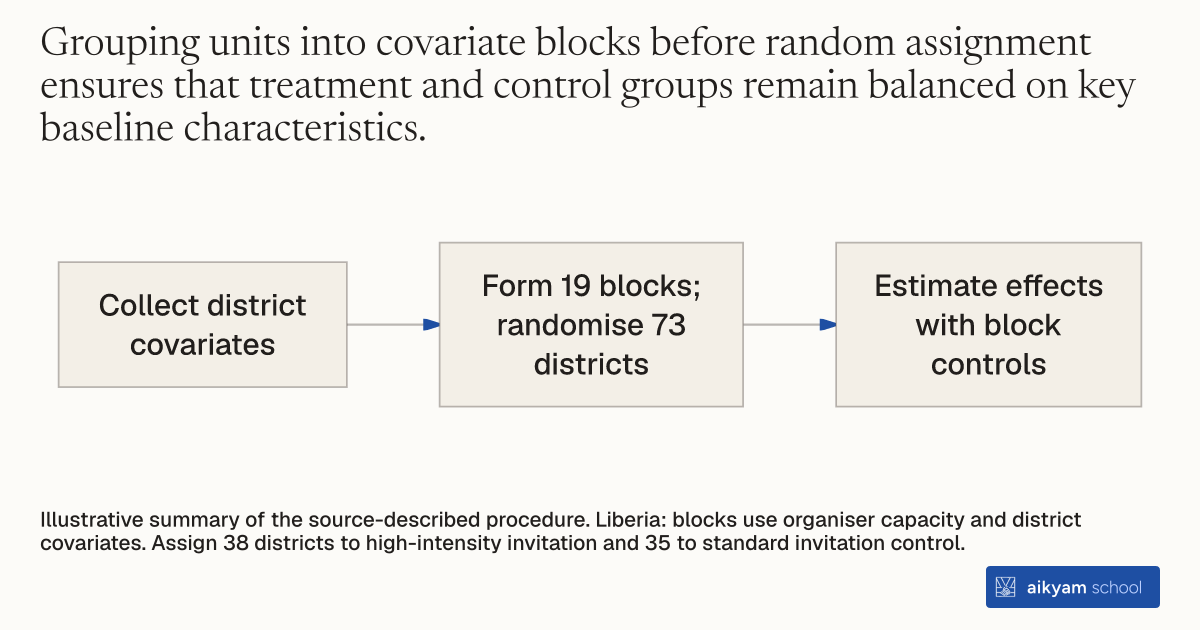
Research steps
Assign districts within blocks
- Collect district covariates
- Form 19 blocks; randomise 73 districts
- Estimate effects with block controls
Illustrative summary of the source-described procedure. Liberia: blocks use organiser capacity and district covariates. Assign 38 districts to high-intensity invitation and 35 to standard invitation control.
See source →How
When to use
In large-scale field experiments across administrative regions, simple random assignment can create baseline imbalance across treatment arms. Evaluators need an experimental assignment method that ensures balance across regional features and implementation capacity. This method assigns administrative units to treatment conditions within stratified blocks of similar units.
Randomize administrative units into treatment conditions using stratified covariate block assignment.
- Program managers collect baseline administrative and geographical covariates for all targeted electoral units prior to treatment implementation.
- Analysts group administrative units into small blocks of similar characteristics based on geographical proximity, baseline electoral covariates, and field organizer operational capacity.
- Analysts apply random assignment within each block to allocate units to treatment and control arms in near-equal proportions.
- Researchers estimate treatment effects using block fixed effects in regression models to account for the stratified design.
Why it works
This reduces variance and prevents operational imbalances across implementation regions.
Example
Researchers stratified all 73 electoral districts in Liberia into 19 blocks based on organizer capacity and baseline district covariates prior to the 2017 election. Within these 19 blocks, 38 districts were randomly assigned to high-intensity debate invitation and 35 districts were assigned to standard invitation control.
About the study
Participants
73 electoral districts across Liberia ahead of the October 2017 legislative election.
Study Design
Block-randomized field experiment stratifying 73 districts across 19 blocks using baseline covariates and field organizer capacity, assigning 38 districts to treatment and 35 to control.
Results
Achieved balance across 38 treated and 35 control districts across 19 randomization blocks with no statistically significant baseline differences in candidate participation or voter demographics.