Research allocation
Assign whole villages within sub-counties
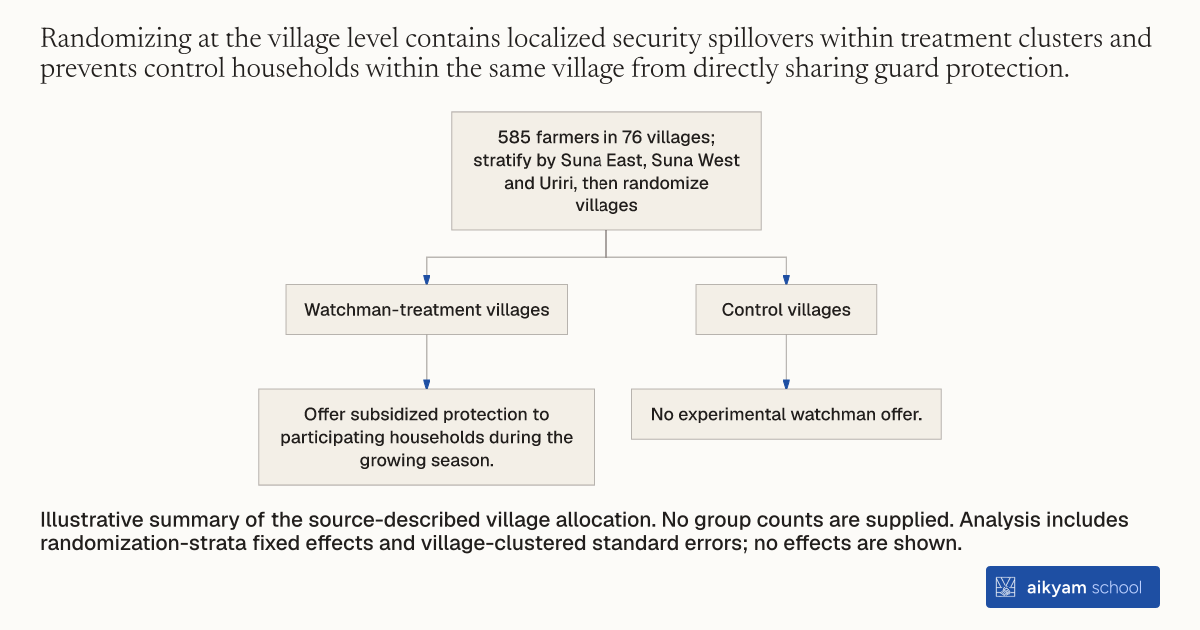
585 farmers in 76 villages; stratify by Suna East, Suna West and Uriri, then randomize villages
- Watchman-treatment villages
- Offer subsidized protection to participating households during the growing season.
- Control villages
- No experimental watchman offer.
Illustrative summary of the source-described village allocation. No group counts are supplied. Analysis includes randomization-strata fixed effects and village-clustered standard errors; no effects are shown.
See source →How
When to use
Evaluating security interventions or local public goods risks spillover contamination if treatment is randomized at the individual household level within villages. Unassigned neighbors might share guard protection or experience crime displacement. This method randomizes treatment assignment at the village cluster level, stratified by sub-county, to isolate experimental impacts.
Randomize treatment assignment at the village cluster level using sub-county stratification to evaluate localized security impacts.
- Define geographic village clusters across target sub-counties containing approximately ten participating farming households per village.
- Stratify the randomization across sub-counties to ensure balanced geographic coverage across administrative regions.
- Assign entire village clusters to either watchman treatment or control status using a computer random number generator.
- Offer all participating households in assigned treatment villages subsidized watchman protection during the target growing season.
- Include randomization strata fixed effects in econometric specifications and cluster standard errors at the village level.
Why it works
Stratifying by sub-county balances regional agro-ecological and market conditions across treatment arms.
Example
A researcher randomized 585 smallholders across 76 villages in Migori County, Kenya at the village cluster level, stratified across Suna East, Suna West, and Uriri sub-counties. The stratified cluster randomization generated treatment and control groups balanced across 29 baseline demographic and agricultural variables.
About the study
Participants
585 smallholding farmers across 76 villages in Suna East, Suna West, and Uriri sub-counties in Migori County, Kenya.
Study Design
Stratified village-cluster randomized controlled trial with standard errors clustered at the village level and randomization strata fixed effects included in diff-in-diff and ANCOVA models.
Results
Cluster randomization achieved balance across 28 out of 29 baseline covariates (p = 0.82 on resampled joint balance tests), successfully isolating treatment effects including a 39.4 percentage point reduction in low farm security.