Qualitative research
Gather insights at three trial stages
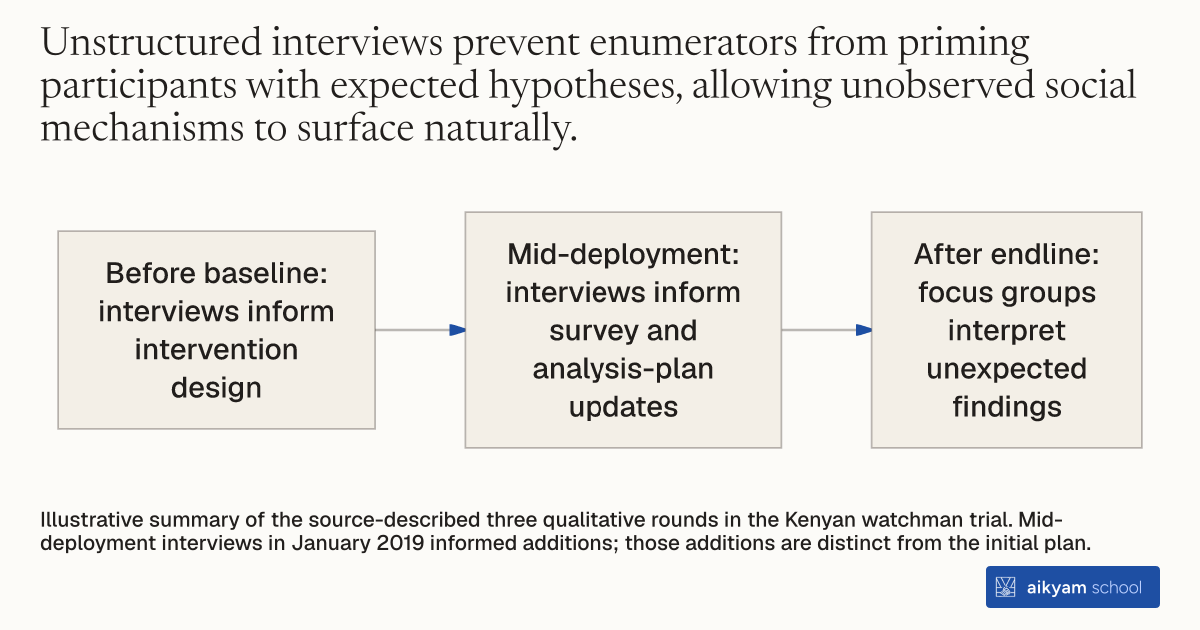
- Before baseline: interviews inform intervention design
- Mid-deployment: interviews inform survey and analysis-plan updates
- After endline: focus groups interpret unexpected findings
Illustrative summary of the source-described three qualitative rounds in the Kenyan watchman trial. Mid-deployment interviews in January 2019 informed additions; those additions are distinct from the initial plan.
See source →How
When to use
Quantitative field trials often fail to capture unexpected behavioral mechanisms or local contextual constraints prior to survey design. Relying solely on rigid baseline surveys can miss key emerging impacts like conflict reduction or labor reallocation. This method gathers qualitative insights across three distinct trial stages to refine intervention design and update survey instruments.
Conduct three sequential rounds of unstructured interviews and focus groups to inform trial design, update survey instruments, and explain unexpected survey findings.
- Perform unstructured interviews with target community members prior to baseline surveying to identify key property crime mechanisms and design the intervention.
- Structure the main intervention and randomization strategy based on baseline qualitative findings regarding outsider guard trust and village spillover risks.
- Conduct a mid-deployment week of unstructured interviews with participants to explore emergent behavioral changes in time use and local security.
- Update the endline survey instrument and pre-registered analysis plan using mid-deployment qualitative discoveries.
- Convene targeted focus group discussions led by local coordinators after endline data collection to interpret anomalous or unexpected survey results.
Why it works
Updating survey instruments mid-trial ensures that unexpected secondary outcomes are systematically measured during endline data collection.
Example
A researcher conducted three qualitative data collection rounds with farmers in Migori County, Kenya during a watchman trial. Mid-deployment interviews in January 2019 revealed unexpected changes in off-farm labor and local dispute counts, enabling the researcher to add these outcomes to the endline survey and pre-registered analysis plan.
About the study
Participants
585 smallholder survey respondents across 76 villages in Migori County, Kenya, supplemented by targeted sub-samples of farmers for qualitative focus groups.
Study Design
Three-stage qualitative data collection (pre-baseline unstructured interviews, mid-deployment unstructured interviews, and post-endline focus groups) integrated with a cluster-randomized trial.
Results
Mid-deployment qualitative interviews successfully identified unanticipated secondary impacts, leading to endline survey additions that documented a 27 percentage point drop in neighbor suspicion, a 14 percentage point drop in unexpressed grievances, and a 60% reduction in angry disputes.