Research procedure
Simulate long-term performance-pay policies
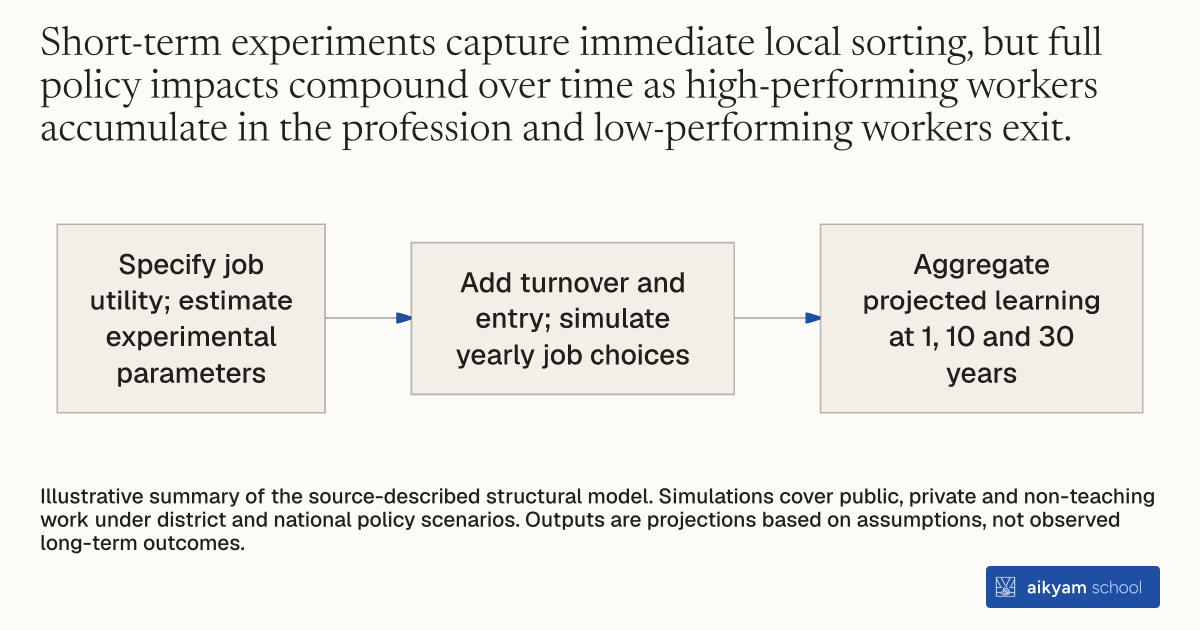
- Specify job utility; estimate experimental parameters
- Add turnover and entry; simulate yearly job choices
- Aggregate projected learning at 1, 10 and 30 years
Illustrative summary of the source-described structural model. Simulations cover public, private and non-teaching work under district and national policy scenarios. Outputs are projections based on assumptions, not observed long-term outcomes.
See source →How
When to use
Schools and policymakers need to predict the long-run equilibrium impact of district-wide or national performance pay policies before costly implementation. Short-term randomized trials observe only immediate local sorting across nearby branches without accounting for multi-year career retention, sector switching costs, or occupational entry. This method uses structural counterfactual simulations built on experimental primitives to project long-term student learning gains under alternative policy scales.
Simulate multi-year counterfactual policy outcomes using experimental sorting primitives, switching costs, and Roy-style occupational utility maximization models.
- Specify an annual job utility function incorporating expected wage growth under performance piece rates, non-wage amenities, and sector-switching friction costs.
- Estimate worker baseline ability, behavioral effort responsiveness, and belief accuracy parameters using experimental trial and survey data.
- Incorporate tenure-dependent worker turnover rates and occupational entry elasticities from administrative personnel records.
- Simulate worker job choice decisions each year across public, private, and non-teaching sectors over 1-year, 10-year, and 30-year policy horizons.
- Aggregate individual teacher composition changes to calculate projected long-run student test score impacts under district and national policy scenarios.
Why it works
Structural modeling combines short-run experimental parameters with long-run switching dynamics to produce realistic general equilibrium predictions.
Example
Researchers simulated a 30-year performance pay policy paying 20 percent of salary via performance incentives across Pakistani school districts. The structural model predicted long-run annual student test score gains of 0.10 to 0.21 standard deviations under district-wide rollout and 0.09 to 0.17 standard deviations under occupation-wide rollout, showing that long-run sorting effects expand total impact by 1.5 to 3.1 times relative to effort response alone.
About the study
Participants
Simulated workforce calibrated on experimental data from 7,000 teachers and 50,000 students across 300 Pakistani private schools, combined with administrative career histories.
Study Design
Structural policy simulation model augmenting a Roy-style job choice framework with estimated experimental parameters (switching costs of $560 for districts and $1,120 for professions, worker utility variances, and belief accuracy).
Results
A 30-year district-wide performance pay policy yields projected annual student learning gains of 0.10 to 0.21 standard deviations (1.5x to 3.1x the pure effort effect), while an occupation-wide policy yields 0.09 to 0.17 standard deviations.