Research steps
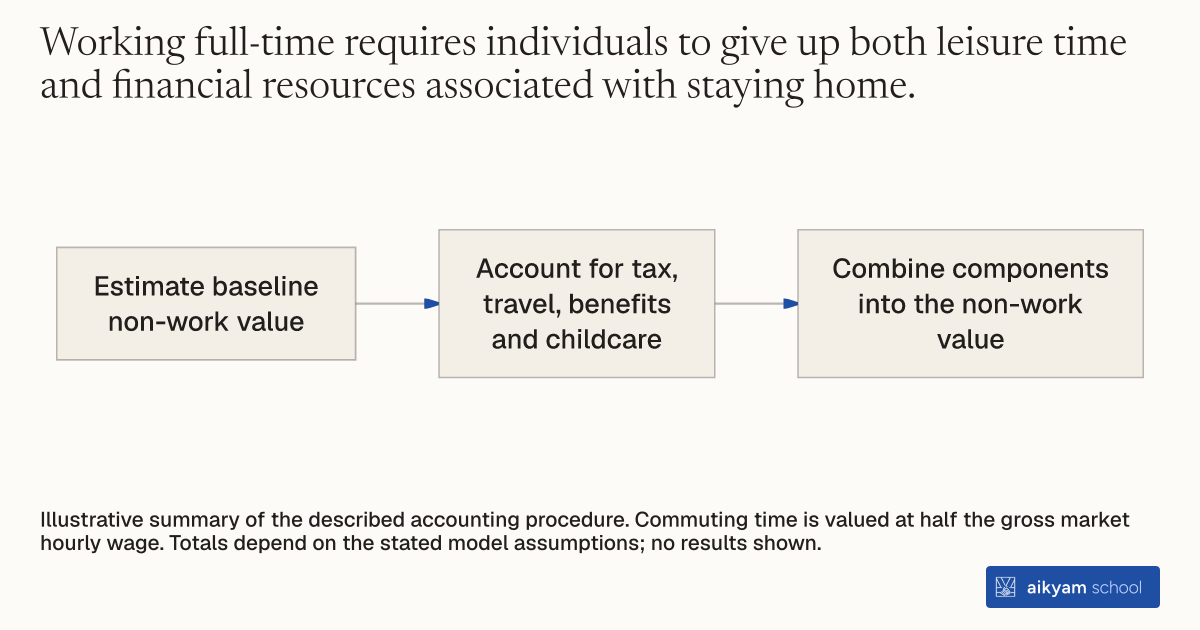
Account for costs of working
- Estimate baseline non-work value
- Account for tax, travel, benefits and childcare
- Combine components into the non-work value
Illustrative summary of the described accounting procedure. Commuting time is valued at half the gross market hourly wage. Totals depend on the stated model assumptions; no results shown.
See source →How
When to use
Macroeconomic search models and public policy analysts need to calculate the true flow value of non-work time for unemployed workers. Baseline experimental leisure valuations exclude workplace participation costs, leading to incomplete opportunity cost estimates. Combining baseline leisure values with taxes, commuting costs, foregone public benefits, and childcare expenses provides a full accounting parameter.
Calculate the comprehensive non-work opportunity cost parameter by incorporating taxes, fixed working expenses, and foregone public support into baseline leisure values.
- Compute baseline leisure and home production flow value relative to predicted pre-tax market wages.
- Adjust the baseline parameter for effective income taxes on marginal product.
- Calculate average daily commuting travel time and value it at half the gross market hourly wage.
- Add the average foregone public assistance benefit loss across unemployment insurance, SNAP, TANF, and Medicaid.
- Factor in average national childcare expenditures as a percentage of weekly worker income.
- Sum all components to calibrate the comprehensive flow value of non-work time parameter z.
Why it works
Accounting for fixed commuting costs, reduced social safety net transfers, and childcare expenses yields the true economic reservation threshold for accepting employment.
Example
Researchers combined an experimental baseline non-work value of 0.58 with an effective tax rate of 20 percent, commuting costs adding 0.06, foregone welfare benefits adding 0.06, and childcare expenses adding 0.023. Under monopsony assumptions, this comprehensive accounting produced a total opportunity cost parameter of z = 0.72.
About the study
Participants
N = 1,152 unemployed field experiment job applicants combined with national workforce statistics from the Current Population Survey and Survey of Income and Program Participation.
Study Design
Structural empirical accounting combining experimental discrete choice leisure valuations with administrative data on tax rates, commuting times, benefit loss rates, and national childcare costs.
Results
Combining baseline experimental leisure valuation (0.58) with an effective tax rate (20%), commuting time (+0.06), foregone public benefits (+0.06), and childcare (+0.023) yielded a preferred opportunity cost parameter of z = 0.72 under monopsony models and z = 0.87 under Diamond-Mortensen-Pissarides models.