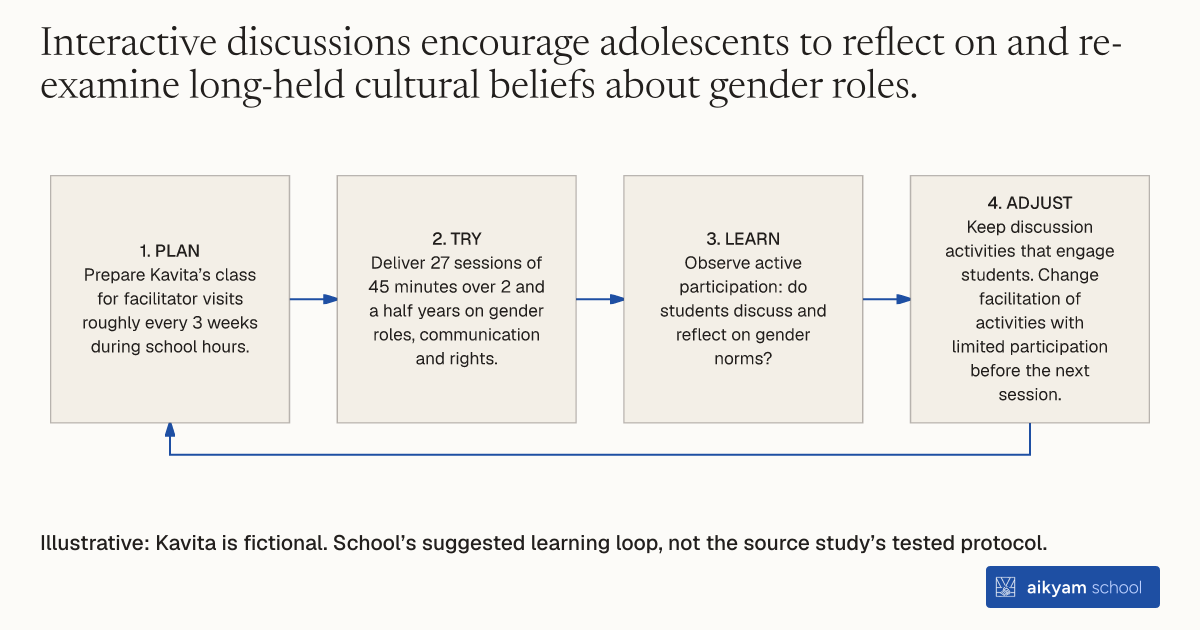
Try, learn and adjust
Check participation in gender equality lessons
- Plan: Prepare Kavita’s class for facilitator visits roughly every 3 weeks during school hours.
- Try: Deliver 27 sessions of 45 minutes over 2 and a half years on gender roles, communication and rights.
- Learn: Observe active participation: do students discuss and reflect on gender norms?
- Adjust: Keep discussion activities that engage students. Change facilitation of activities with limited participation before the next session.
Illustrative: Kavita is fictional. School’s suggested learning loop, not the source study’s tested protocol.
See source →School’s suggested learning loop: observe lesson delivery and discussion. This loop is separate from the evaluated programme and does not establish changes in attitudes or behaviour.
How
When to use
Adolescents in low-income regions often hold gender-discriminatory views shaped by entrenched cultural norms. This method addresses gender bias and unequal social expectations among secondary school students. It provides a structured school-based approach for boys and girls aged 11 to 15.
Deliver interactive classroom sessions to secondary school students during regular school hours over multiple academic years.
- Hired facilitators visit participating government schools roughly every three weeks during the academic year.
- Facilitators conduct twenty-seven 45-minute interactive classroom sessions over two and a half years with students in grades 7 and 8.
- Facilitators guide students through structured discussion topics focused on household chores, gender roles, communication skills, and equal rights.
- Facilitators present both economic arguments and human rights-based reasoning to demonstrate the value of girls and women.
- Facilitators encourage active student participation to challenge existing biased perceptions and reflect on social norms.
Why it works
Discussing these topics at a critical developmental age allows students to internalise equitable principles and recognise shared community support for gender equality.
Example
Non-profit facilitators delivered 27 interactive sessions across 150 government schools in Haryana, India, reaching adolescents in grades 7 and 8. The intervention increased gender attitude index scores by 0.25 standard deviations and shifted discriminatory views to gender-equal stances in 14 percent of cases.
About the study
Participants
Nearly 15,000 students in grades 7–8 (aged 11–15) across 314 government schools in Haryana, India.
Study Design
School-level cluster randomized controlled trial comparing 150 treatment schools receiving the program to 164 control schools.
Results
Gender attitude index increased by 0.25 standard deviations, gender-specific behavior index increased by 0.32 standard deviations (0.46 for boys, 0.21 for girls), and the likelihood of believing women should be allowed to work increased by 12.9 percentage points.