Research procedure
Sample across subcaste networks
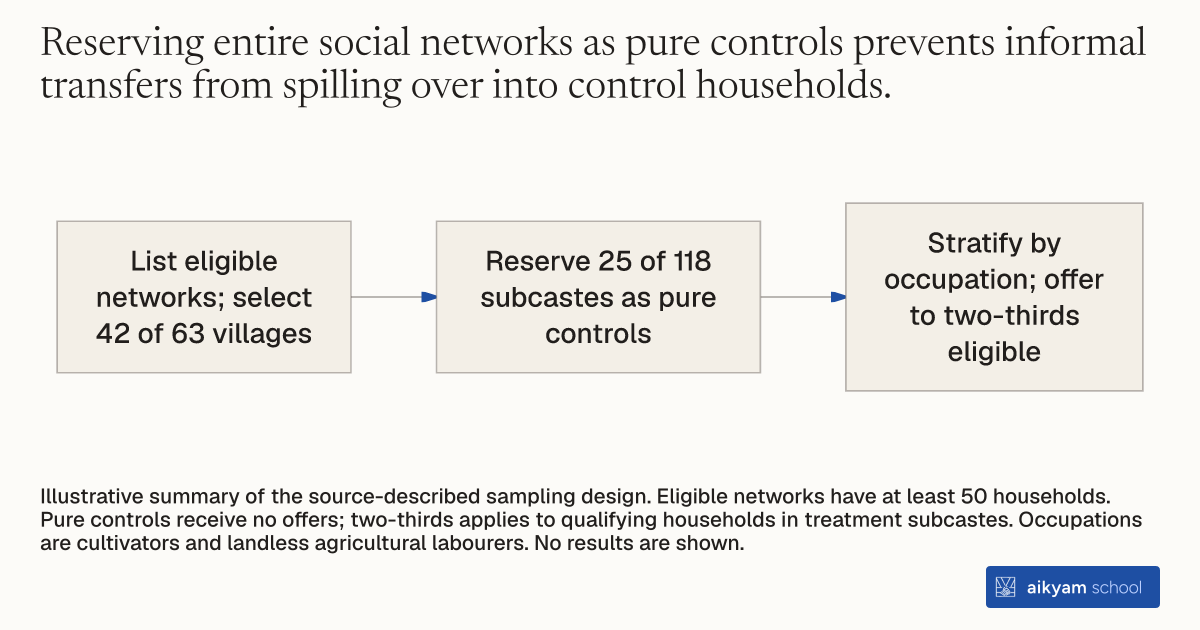
- List eligible networks; select 42 of 63 villages
- Reserve 25 of 118 subcastes as pure controls
- Stratify by occupation; offer to two-thirds eligible
Illustrative summary of the source-described sampling design. Eligible networks have at least 50 households. Pure controls receive no offers; two-thirds applies to qualifying households in treatment subcastes. Occupations are cultivators and landless agricultural labourers. No results are shown.
See source →How
When to use
Researchers need to evaluate financial products within traditional social networks without contaminating control groups. Standard village-level randomization fails to isolate network-level informal risk sharing and spillovers. Stratifying random assignment across and within subcaste networks enables precise measurement of informal safety nets.
Sample and assign interventions across social networks using census listing data to isolate community risk-sharing effects.
- Extract census listing data for households across target villages to identify unique subcaste networks containing at least 50 households.
- Select 42 out of 63 sample villages to receive the program intervention.
- Reserve 25 out of 118 subcastes as pure control groups so their members receive no intervention offers.
- Stratify treatment subcaste households by occupation into land-cultivating farmers and landless agricultural laborers.
- Offer the intervention to two-thirds of qualifying households within treatment subcastes.
Why it works
Stratifying within networks creates natural variation in treatment density across villages to measure general-equilibrium spillovers.
Example
Researchers in 63 Indian villages used census listing data covering 118 jatis with over 50 households to randomize rainfall insurance offers among 4,667 households, keeping 25 jatis as pure controls while varying village labor treatment coverage from 0 percent to 80 percent.
About the study
Participants
4,667 households (cultivators and landless laborers) across 63 villages and 93 treatment subcastes in rural India.
Study Design
Randomized controlled trial stratified across 118 subcastes (25 pure control subcastes, 93 treatment subcastes) and occupation types.
Results
Marketing coverage ranged from 0 percent to 56 percent for cultivators and 0 percent to 80 percent for laborers across treatment villages, allowing unbiased estimation of general equilibrium wage spillovers.