Research steps
List households before stratified sampling
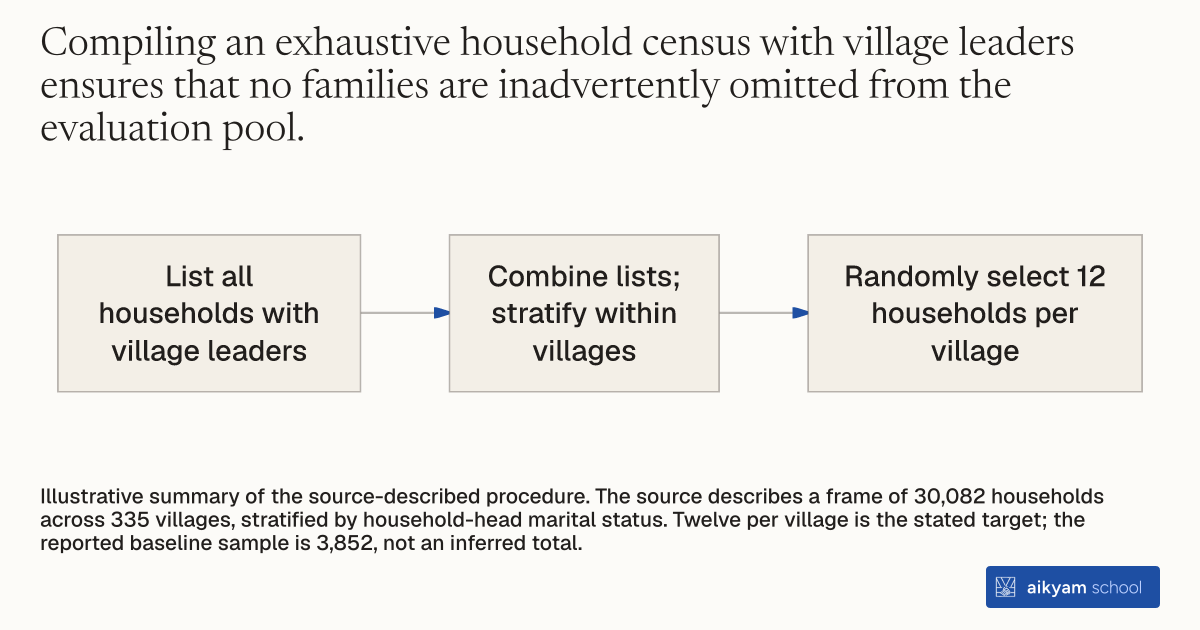
- List all households with village leaders
- Combine lists; stratify within villages
- Randomly select 12 households per village
Illustrative summary of the source-described procedure. The source describes a frame of 30,082 households across 335 villages, stratified by household-head marital status. Twelve per village is the stated target; the reported baseline sample is 3,852, not an inferred total.
See source →How
When to use
Evaluators conducting surveys in rural communities need an unbiased sampling frame to measure program impacts across a target population. Relying on incomplete local records or unverified lists leads to selection bias and excludes vulnerable families. This approach constructs a comprehensive household frame to randomly select survey participants representative of entire rural villages.
Construct a representative village sampling frame and randomly select survey households stratified by household head characteristics.
- Work directly with village leadership to compile a complete census listing of all households residing within each target community.
- Consolidate individual community lists into a comprehensive study-wide sampling frame containing all identified households across the evaluation area.
- Stratify the household sampling frame within each village based on demographic criteria, such as the marital status of the household head.
- Randomly select a fixed target sample of 12 households per village from the stratified list to participate in baseline and follow-up evaluation surveys.
Why it works
Stratifying random selection on key demographic traits like marital status guarantees that the sample accurately reflects the demographic distribution of the community.
Example
In western Uganda, researchers collaborated with village leaders to construct a sampling frame of 30,082 households across 335 villages, randomly selecting 12 households per village stratified by marital status to survey nearly 4,000 households at baseline.
About the study
Participants
3,852 households across 335 villages in Kagadi and Kyenjojo districts, western Uganda, where 35% of households fall below the $2.15 PPP daily poverty line post-harvest and 65% during the lean season.
Study Design
Clustered randomized controlled trial across 114 village clusters covering 335 villages, comparing a universal livelihoods program to a pure control group.
Results
Listing yielded a sampling frame of 30,082 households across 335 villages, from which a baseline sample of 3,852 households was randomly selected (12 per village stratified by marital status), achieving an 8% endline attrition rate uncorrelated with treatment.