Research sampling
Sample voters from electoral registers
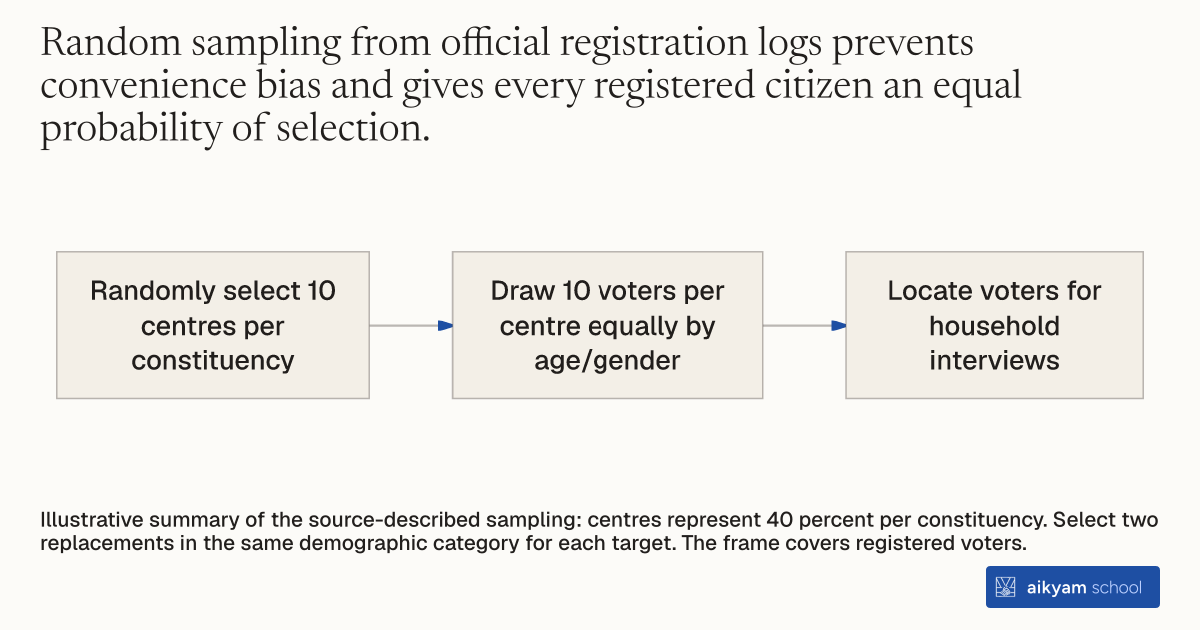
- Randomly select 10 centres per constituency
- Draw 10 voters per centre equally by age/gender
- Locate voters for household interviews
Illustrative summary of the source-described sampling: centres represent 40 percent per constituency. Select two replacements in the same demographic category for each target. The frame covers registered voters.
See source →How
When to use
When surveying citizens across geographically dispersed rural constituencies, convenience sampling or unverified lists risk introducing severe selection bias. Relying on official voter registration records with stratified random selection guarantees a representative sample across age and gender categories. This method helps survey teams select unbiased representative samples of citizens for public opinion research.
Select a representative sample of registered voters by drawing from official electoral registration logs using two-stage stratified random sampling.
- Obtain official voter registry lists containing names, demographic details, and home addresses from the national electoral commission.
- Randomly select 10 voter registration centers per constituency, representing 40 percent of total centers.
- Randomly select 10 target voters per selected registration center from the official registry list.
- Stratify the selection of individual voters equally across age and gender categories.
- Identify two potential replacement voters from the same demographic category for each primary target voter in case the primary contact is unavailable.
- Deploy enumerator teams to locate sampled voters at their home residences to conduct face-to-face interviews.
Why it works
Stratifying by age and gender ensures that survey responses accurately mirror the demographic structure of the constituency population.
Example
Researchers sampled registered voters in 80 Parliamentary constituencies across Sierra Leone for the 2018 elections by drawing 10 voter registration centers per constituency from National Electoral Commission lists and selecting 10 voters per center stratified by age and gender. Across surveyed constituencies, enumerators reached an average of 94 voters per constituency, where 67 percent were primary targets, 20 percent were first replacements, and 13 percent were second replacements.
About the study
Participants
7,544 registered voters sampled across 80 Parliamentary constituencies in Sierra Leone, where 43 percent had no formal schooling and 47 percent were male, with an average age of 37.37 years.
Study Design
A two-stage stratified cluster random sampling protocol using National Electoral Commission registry lists across 10 registration centers per constituency, with in-person household surveys.
Results
The sampling method achieved a high respondent contact rate averaging 94 completed voter surveys per constituency, with 67 percent reached on the first target attempt, 20 percent on the first replacement, and 13 percent on the second replacement.