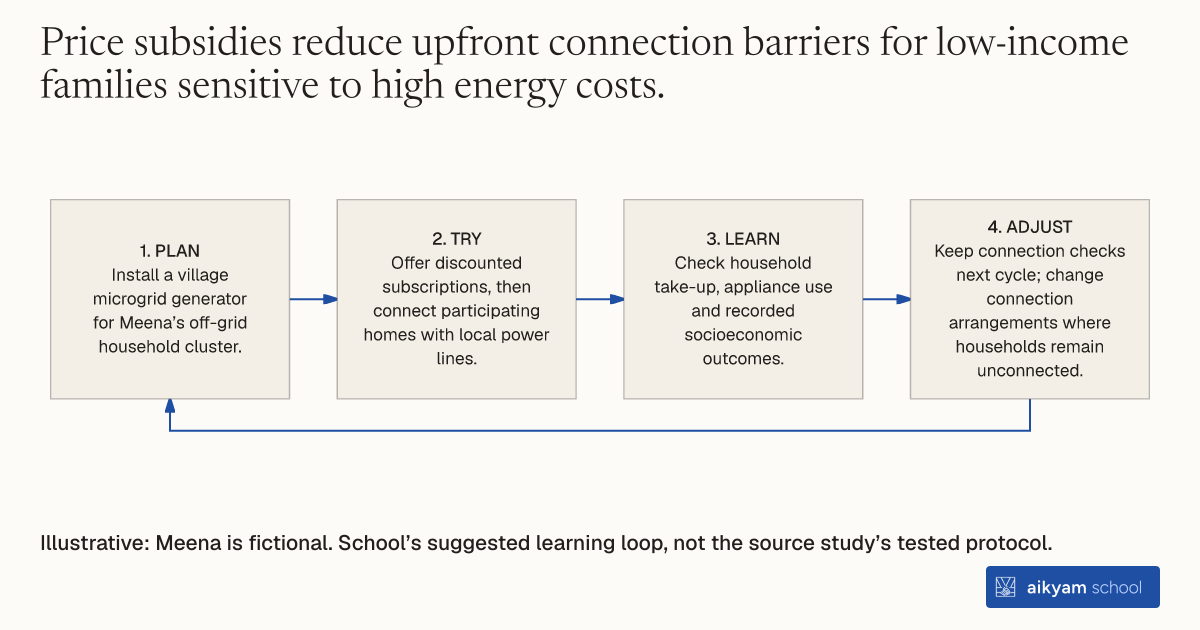
Try, learn and adjust
Check subsidised microgrid connections
- Plan: Install a village microgrid generator for Meena’s off-grid household cluster.
- Try: Offer discounted subscriptions, then connect participating homes with local power lines.
- Learn: Check household take-up, appliance use and recorded socioeconomic outcomes.
- Adjust: Keep connection checks next cycle; change connection arrangements where households remain unconnected.
Illustrative: Meena is fictional. School’s suggested learning loop, not the source study’s tested protocol.
See source →School’s suggested, untested loop. Observe take-up, appliance use and socioeconomic outcomes. The India example found no measured labour, income or health impacts.
How
When to use
Many rural communities lack access to main electrical grids due to geographical isolation or slow infrastructure rollouts. Operators install privately operated community solar microgrids that connect groups of nearby households. Providing price subsidies lowers upfront connection charges for low-income residents.
Offer subsidized connection rates for community solar microgrids to groups of off-grid rural households.
- Solar energy providers install decentralized microgrid generators in off-grid rural villages.
- Program operators offer village household clusters microgrid connection contracts at discounted subscription fees.
- Technicians run local power lines from the solar microgrid array directly into connected homes.
- Managers track household electricity take-up rates, appliance usage, and socioeconomic outcomes over time.
Why it works
Microgrids provide immediate basic power for lighting and phone charging when national grid expansion is delayed.
Example
In rural India, researchers offered subsidized community solar microgrids to household clusters in Uttar Pradesh and Bihar, increasing connection likelihood by 13.3 percentage points at half-price.
About the study
Participants
Off-grid rural households in Uttar Pradesh and Bihar, India.
Study Design
Randomized Controlled Trials evaluating subsidized access to privately operated solar microgrids across groups of rural households.
Results
Households in India were 13.3 percentage points more likely to connect to a solar microgrid at half-price relative to full price. In Uttar Pradesh and Bihar, microgrid connections had no measured impacts on labor, income, or health, with positive but imprecise effects on reading test scores.