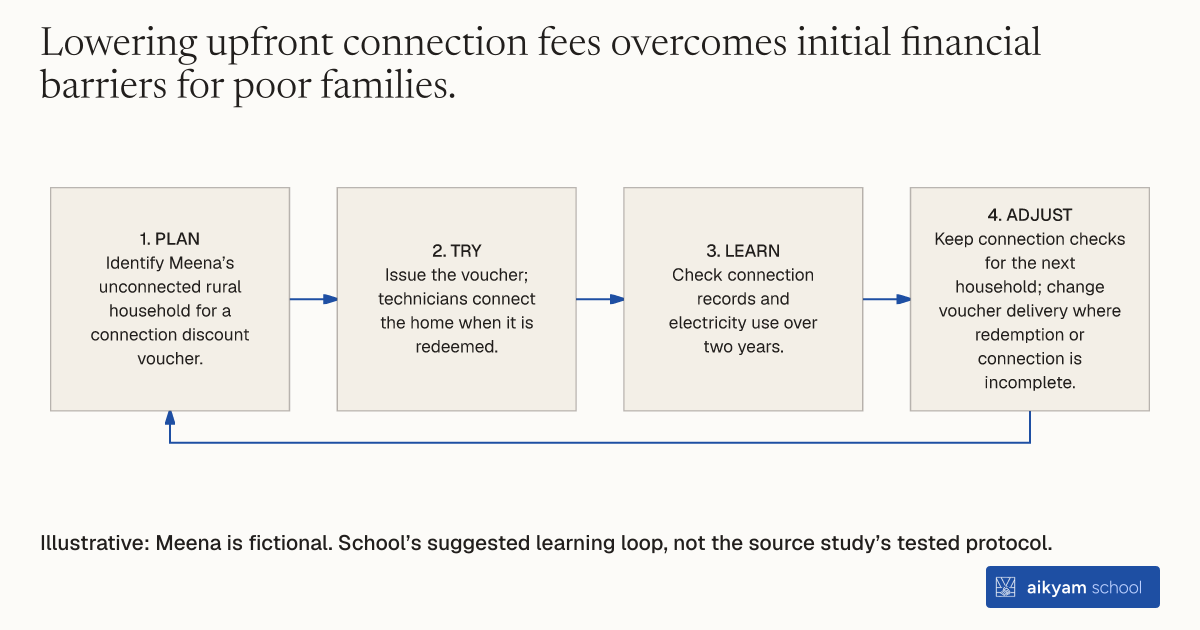
Try, learn and adjust
Check grid voucher redemption and connection
- Plan: Identify Meena’s unconnected rural household for a connection discount voucher.
- Try: Issue the voucher; technicians connect the home when it is redeemed.
- Learn: Check connection records and electricity use over two years.
- Adjust: Keep connection checks for the next household; change voucher delivery where redemption or connection is incomplete.
Illustrative: Meena is fictional. School’s suggested learning loop, not the source study’s tested protocol.
See source →School’s suggested, untested loop. Observe connection rates and electricity use over two years; this check does not establish health effects.
How
When to use
Low-income rural households rely on polluting fuels because upfront grid connection fees are unaffordable. Program managers deploy price subsidies or discount vouchers to lower financial barriers to entry. This approach helps poor families access clean electric power for their homes.
Offer subsidized discount vouchers to low-income households to lower upfront electrical grid connection fees.
- Local energy agencies identify unconnected rural households using dirty fuels like kerosene.
- Program administrators issue discount vouchers that cover part or all of the grid connection cost.
- Utility technicians connect the households to the electrical power grid upon redemption of the voucher.
- Program officers monitor household connection rates and ongoing electricity consumption over two years.
Why it works
Replacing kerosene lighting with electricity reduces overnight indoor smoke and cuts respiratory illness.
Example
In El Salvador, program managers distributed grid connection discount vouchers to low-income households, leading to cleaner indoor air and fewer childhood respiratory infections over two years.
About the study
Participants
Low-income rural households with young children in El Salvador and Kenya.
Study Design
Randomized Controlled Trial evaluating subsidized grid connection vouchers over a two-year period.
Results
In El Salvador, voucher recipients had lower overnight indoor air pollution and between 8-14 percent fewer instances of related child respiratory infections after two years. In Kenya, a 57 percent subsidy achieved a 23 percent connection rate, while a 29 percent subsidy achieved a 6 percent connection rate.