Research design
Describe READI’s combined support
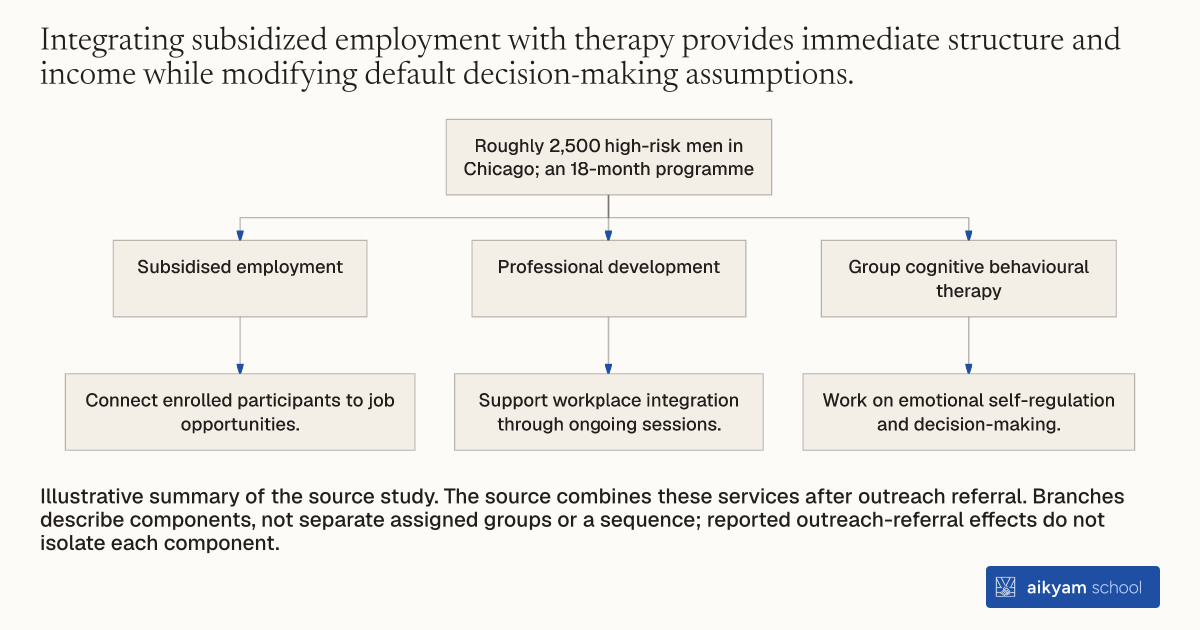
Roughly 2,500 high-risk men in Chicago; an 18-month programme
- Subsidised employment
- Connect enrolled participants to job opportunities.
- Professional development
- Support workplace integration through ongoing sessions.
- Group cognitive behavioural therapy
- Work on emotional self-regulation and decision-making.
Illustrative summary of the source study. The source combines these services after outreach referral. Branches describe components, not separate assigned groups or a sequence; reported outreach-referral effects do not isolate each component.
See source →How
When to use
Individuals at high risk of involvement in gun violence often face disconnection from public services and economic opportunities. Combining subsidized job opportunities with cognitive behavioral therapy engages high-risk individuals and addresses underlying cognitive biases. Deliver a combined economic and behavioral intervention to reduce serious gun violence involvement.
Provide a combined intervention of subsidized employment, professional development, and group cognitive behavioral therapy over an 18-month period.
- Outreach workers identify and refer men at highest risk of involvement in gun violence.
- Program staff connect enrolled participants to subsidized employment opportunities.
- Staff conduct ongoing professional development sessions to support workplace integration.
- Facilitators lead group-based cognitive behavioral therapy sessions to improve emotional self-regulation and decision-making.
Why it works
This dual structure successfully engages disconnected individuals who typically do not participate in state programs.
Example
Implementers in Chicago delivered the Rapid Employment and Development Initiative (READI) to roughly 2,500 men at highest risk of gun violence over an 18-month period. Participants referred by outreach workers experienced a 79 percent reduction in arrests for shooting and homicides and a 43 percent reduction in victimizations for the same types of crime.
About the study
Participants
Roughly 2,500 men at highest risk of gun violence involvement in Chicago.
Study Design
Randomized controlled trial measuring serious violence, arrests, and victimizations over an 18-month intervention period.
Results
Outreach worker referrals experienced a 0.13 standard deviation reduction in serious violence, driven by a 79 percent reduction in arrests for shooting and homicides and a 43 percent reduction in victimizations, generating US$182,000 to US$916,000 in social benefits per participant at a cost of US$52,000.