Try, learn and adjust
Check agreed guard duties and timing are followed
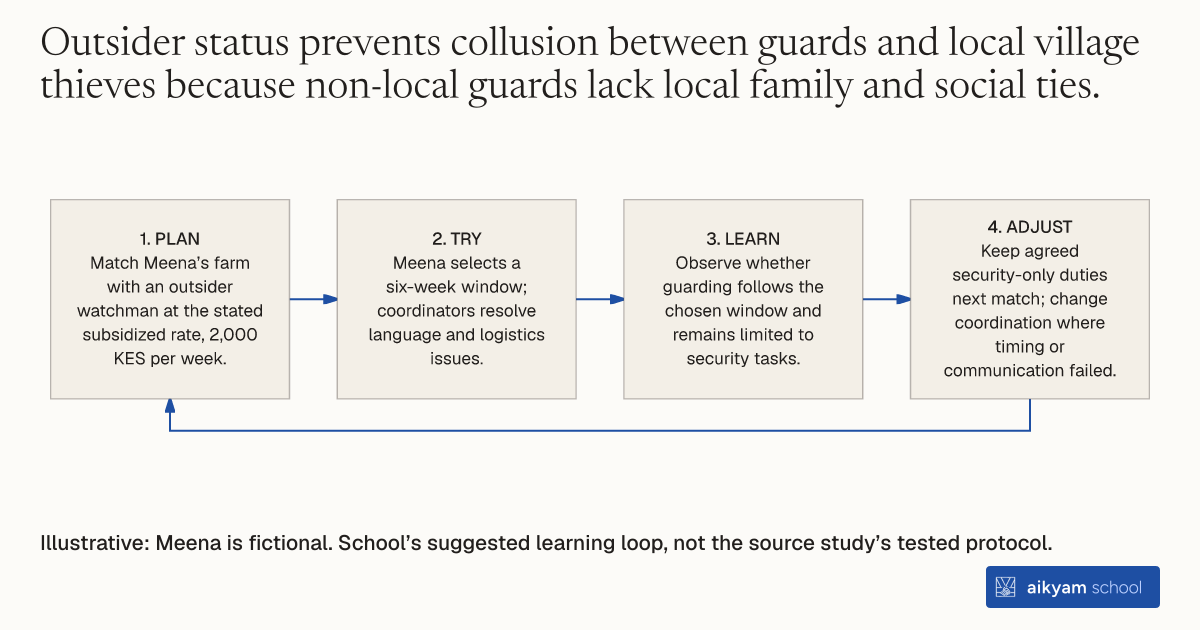
- Plan: Match Meena’s farm with an outsider watchman at the stated subsidized rate, 2,000 KES per week.
- Try: Meena selects a six-week window; coordinators resolve language and logistics issues.
- Learn: Observe whether guarding follows the chosen window and remains limited to security tasks.
- Adjust: Keep agreed security-only duties next match; change coordination where timing or communication failed.
Illustrative: Meena is fictional. School’s suggested learning loop, not the source study’s tested protocol.
See source →Selected window, security-only work and coordination; no assumed theft reduction. School’s suggested learning loop, not a source-tested cycle.
How
When to use
Smallholder farmers in rural areas face high crop theft risks that distort their crop choices and time allocation. Local watchmen often have social ties that lead to collusion or high social costs when confronting thieves. This method provides affordable property protection using trusted non-local guards.
Deploy subsidized non-local guards to protect smallholder farm plots during vulnerable crop growth periods.
- Match participating smallholder farmers with watchmen recruited from an outside ethnic group or region with a reputation for property protection.
- Set uniform subsidized wage rates and guard duration in advance so protection costs remain affordable for participating farmers.
- Allow each farmer to select the specific six-week guarding window during the growing season when their crops face the highest theft risk.
- Restrict guard duties strictly to security tasks to prevent farmers from using guards for regular agricultural field labor.
- Deploy field coordinators to monitor guard activities and resolve language or logistical barriers between guards and farmers.
Why it works
Cultural stereotypes regarding pastoralist guards further increase deterrence against opportunistic property crime.
Example
Research teams matched smallholders in rural Kenya with Maasai watchmen for six weeks of farm guarding during the short rains season. Farmers paid a subsidized rate of 2,000 KES per week for guard services. Participating farmers experienced a 32.5 percentage point drop in crop theft and increased off-farm crop sales.
About the study
Participants
585 smallholding farmers across 76 villages in Suna East, Suna West, and Uriri sub-counties, Migori County, Kenya.
Study Design
Cluster-randomized field experiment comparing households matched with subsidized Maasai watchmen against non-matched control households across baseline and endline surveys.
Results
86% of offered farmers hired watchmen, increasing watchman adoption by 72 percentage points, reducing reported low farm security by 39.4 percentage points, decreasing perceived high theft risk for high-value crops by 26.2 percentage points, and cutting actual crop theft by 32.5 percentage points.