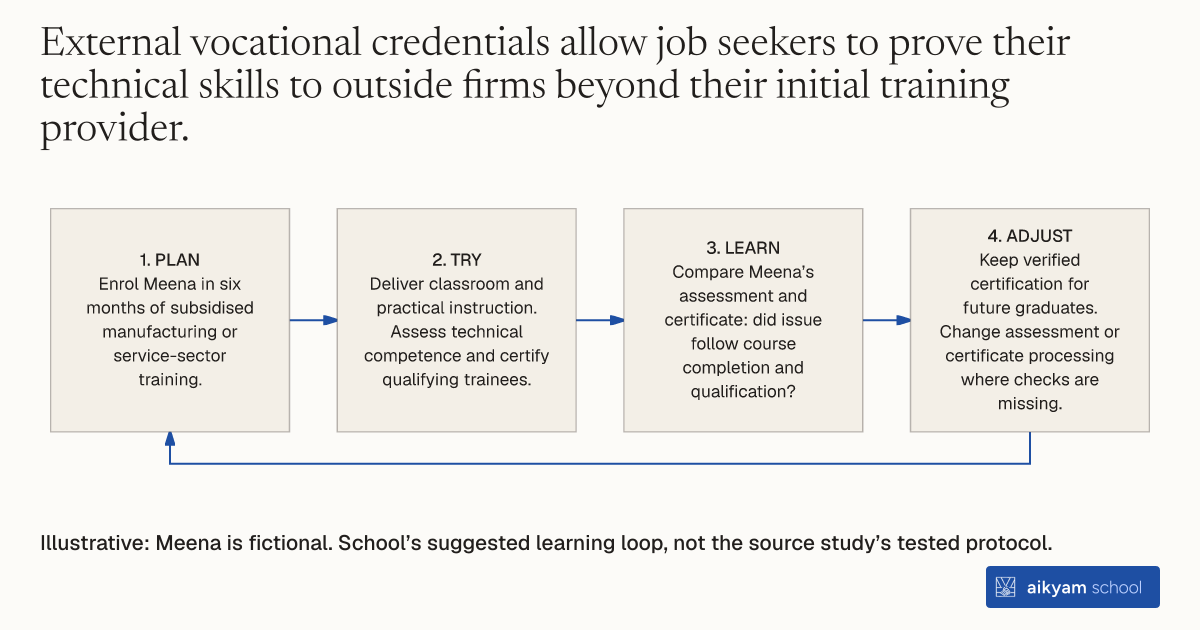
Try, learn and adjust
Check vocational credentials follow assessment
- Plan: Enrol Meena in six months of subsidised manufacturing or service-sector training.
- Try: Deliver classroom and practical instruction. Assess technical competence and certify qualifying trainees.
- Learn: Compare Meena’s assessment and certificate: did issue follow course completion and qualification?
- Adjust: Keep verified certification for future graduates. Change assessment or certificate processing where checks are missing.
Illustrative: Meena is fictional. School’s suggested learning loop, not the source study’s tested protocol.
See source →School’s suggested, untested loop. Observe training completion, competency assessment and credentials. This check does not establish an advantage over apprenticeships.
How
When to use
Job seekers entering manufacturing or service sectors lack portable credentials to certify their capabilities to prospective employers. In-firm apprenticeships provide practical experience but fail to deliver externally recognized certificates. This method provides structured vocational training coupled with portable skill certification.
Deliver subsidized sector-specific vocational training through an accredited organization to provide workers with portable skill credentials.
- NGO trainers recruit young job seekers interested in manufacturing or service sector occupations.
- Instructors deliver six months of subsidized, sector-specific classroom and practical vocational instruction.
- Organization evaluators test trainees on technical competency upon course completion.
- Program directors issue official completion certificates to qualifying trainees to use during external job searches.
Why it works
Portable skill signals help workers secure more job offers and transition back into employment faster after unemployment spells.
Example
In Uganda, researchers evaluated a subsidized six-month sector-specific vocational training program conducted by the nongovernmental organization BRAC in manufacturing and service sectors compared to subsidized in-firm apprenticeships. Long-term follow-up showed that vocational trainees received more job offers and achieved higher overall employment rates than firm apprentices because trainees could better certify their skills to prospective employers.
About the study
Participants
Human youth job seekers in manufacturing and service sectors in urban areas of Uganda.
Study Design
Randomized evaluation comparing six-month BRAC vocational training to subsidized in-firm apprenticeships across manufacturing and service industries.
Results
In the long run, vocational trainees received more job offers and maintained higher rates of employment than firm-provided trainees due to superior skill certification.