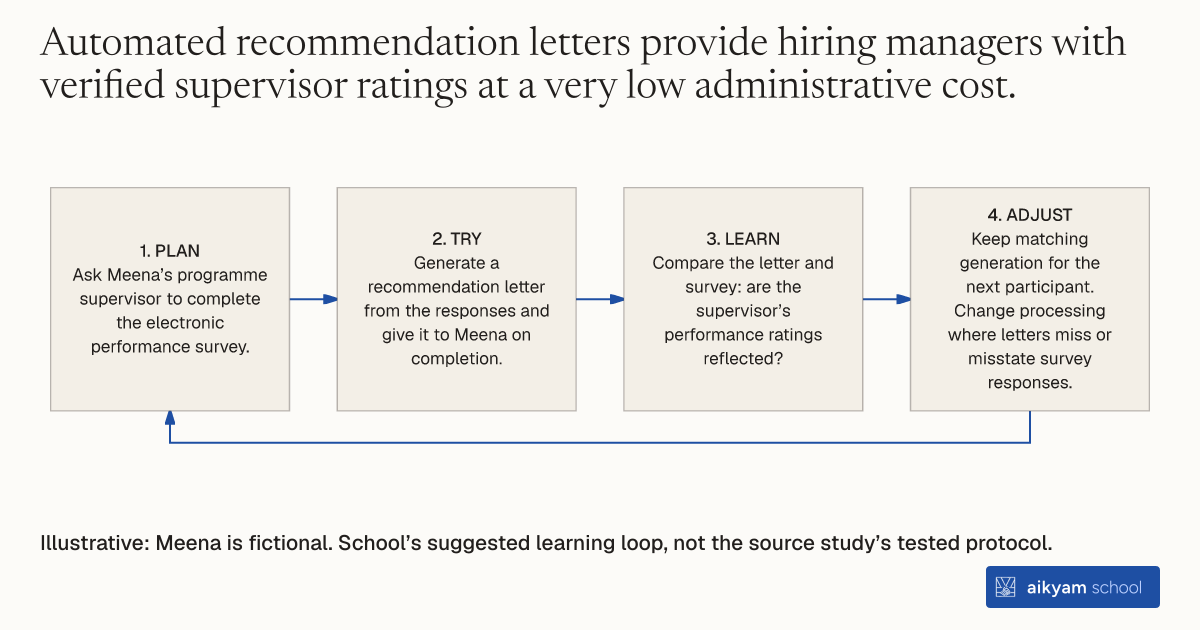
Try, learn and adjust
Check generated letters reflect supervisor ratings
- Plan: Ask Meena’s programme supervisor to complete the electronic performance survey.
- Try: Generate a recommendation letter from the responses and give it to Meena on completion.
- Learn: Compare the letter and survey: are the supervisor’s performance ratings reflected?
- Adjust: Keep matching generation for the next participant. Change processing where letters miss or misstate survey responses.
Illustrative: Meena is fictional. School’s suggested learning loop, not the source study’s tested protocol.
See source →School’s suggested, untested loop. Observe survey completion, letter content and delivery. This check does not establish earnings effects.
How
When to use
Young job seekers completing summer work programs lack credible work records to show prospective hiring managers. Employers face uncertainty when assessing entry-level candidates without verified supervisor feedback. This method enables program directors to issue verified recommendation letters efficiently.
Administer automated supervisor surveys following program completion to generate standardized recommendation letters for young job seekers.
- Program supervisors complete a brief electronic survey regarding participant performance and workplace ratings.
- Program software automatically processes survey responses into complete recommendation letters for each youth participant.
- Distribute generated recommendation letters directly to participants upon program completion.
- Participants present recommendation letters to employers when applying for positions in higher-paying sectors.
Why it works
Credible performance details allow candidates to secure job interviews faster and stay in employment longer.
Example
In New York, young participants in the Summer Youth Employment Program received recommendation letters generated automatically from supervisor surveys. Youth who received recommendation letters cumulatively earned US$1,349 more on average across four years compared to participants without letters.
About the study
Participants
Human youth participants in the Summer Youth Employment Program in New York, United States.
Study Design
Randomized evaluation comparing participants offered automated recommendation letters against a control group, tracking earnings over a four-year longitudinal period.
Results
Participants receiving recommendation letters earned US$1,349 more cumulatively across four years on average and stayed in jobs 0.36 months longer than non-recipients.