Try, learn and adjust
Check certificates match assessed skills
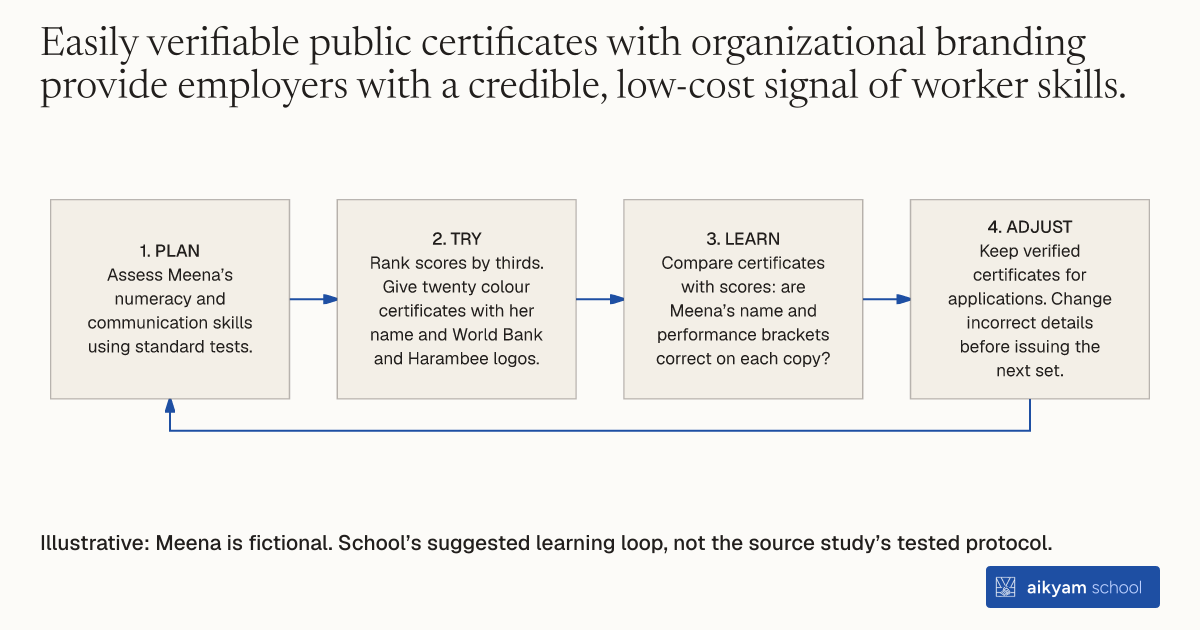
- Plan: Assess Meena’s numeracy and communication skills using standard tests.
- Try: Rank scores by thirds. Give twenty colour certificates with her name and World Bank and Harambee logos.
- Learn: Compare certificates with scores: are Meena’s name and performance brackets correct on each copy?
- Adjust: Keep verified certificates for applications. Change incorrect details before issuing the next set.
Illustrative: Meena is fictional. School’s suggested learning loop, not the source study’s tested protocol.
See source →School’s suggested, untested loop. Observe assessment scores, ranking and certificate copies. This check does not establish hiring effects.
How
When to use
Job seekers in low-information labor markets struggle to showcase or credibly certify their skills to potential employers. Employers face high uncertainty about applicant qualifications when education quality is unknown. This method helps young job seekers present verifiable skill ratings to employers.
Administer objective skill assessments to job seekers and issue public branded performance certificates for use in application processes.
- Assess job seekers on core competencies such as numeracy and communication skills using standardized testing procedures.
- Group assessment results into relative peer performance brackets, ranking candidates into lower third, middle third, or upper third.
- Print physical full-color skill certificates displaying the candidate's name alongside World Bank and Harambee logos.
- Distribute twenty physical certificate copies to each job seeker to attach to their job applications.
Why it works
This reduces information barriers during candidate screening and enables firms to identify better employment matches.
Example
In South Africa, researchers partnered with the Harambee Youth Employment Service to give job seekers branded certificates showing their numeracy and communication skill rankings. Participants received twenty colored copies with their name and World Bank and Harambee logos. Candidates who received the public certificate were 5.2 percentage points more likely to be employed and earned US$130 in the first three months.
About the study
Participants
Young human job seekers in South Africa in partnership with Harambee Youth Employment Service.
Study Design
Randomized evaluation (RCT) comparing public branded certificates against unbranded single-copy certificates and a control group, measuring outcomes 3 to 4 months post-intervention.
Results
Job seekers receiving public branded certificates were 5.2 percentage points more likely to be employed and increased hours worked by 20 percent relative to the control group, earning US$130 over three months (an earnings gain 5.6 times higher than the per-participant program cost).