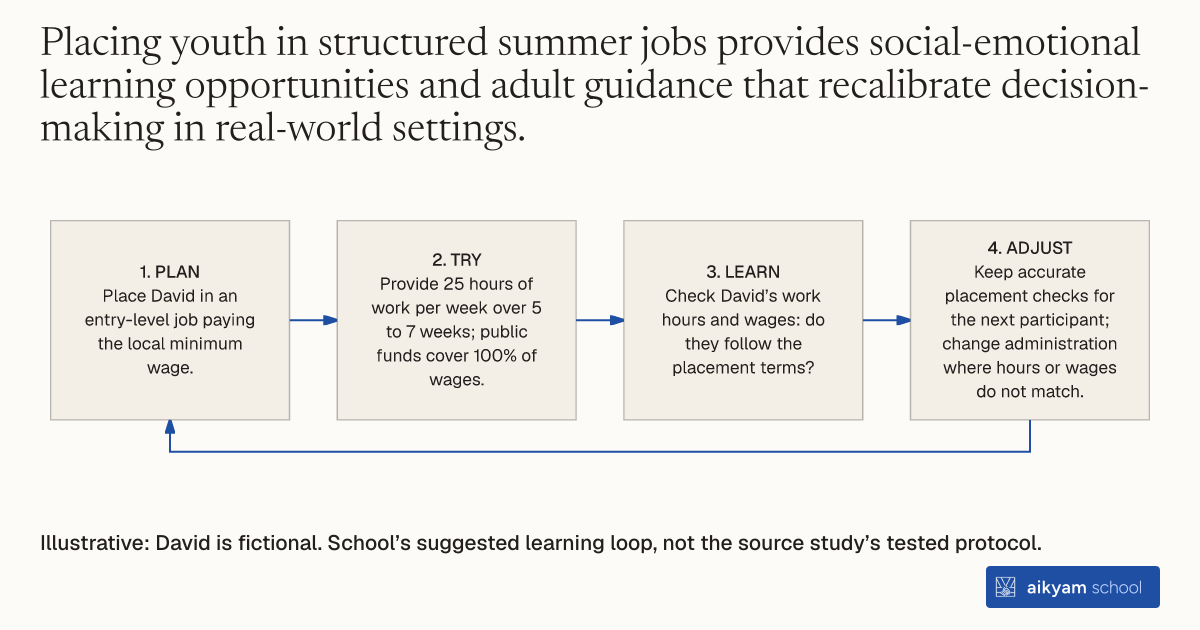
Try, learn and adjust
Check summer job hours and wages
- Plan: Place David in an entry-level job paying the local minimum wage.
- Try: Provide 25 hours of work per week over 5 to 7 weeks; public funds cover 100% of wages.
- Learn: Check David’s work hours and wages: do they follow the placement terms?
- Adjust: Keep accurate placement checks for the next participant; change administration where hours or wages do not match.
Illustrative: David is fictional. School’s suggested learning loop, not the source study’s tested protocol.
See source →School’s suggested, untested learning loop. Observe work hours, placement duration and wage payments; no crime reduction is assumed for David.
How
When to use
Youth in disadvantaged urban neighborhoods face high rates of unemployment and exposure to violent crime. Municipalities need cost-effective strategies to reduce violent crime arrests and mortality among high-risk youth. Subsidized summer jobs provide structured employment and wage earnings during high-risk months.
Provide disadvantaged adolescents with subsidized minimum-wage entry-level employment during the summer months.
- Partner with community providers and municipal employers to identify entry-level job placements.
- Accept program applications from low-income youth ages 14 to 22 in targeted neighborhoods.
- Assign participants to entry-level positions paying the local minimum wage.
- Employ youth for 25 hours per week over 5 to 7 summer weeks.
- Subsidize 100 percent of participant wages using public program funds.
Why it works
This experiential learning helps youth avoid high-risk conflicts even after the job ends.
Example
In New York City, the Summer Youth Employment Program placed over 30,000 disadvantaged youth per year into 5 to 7 week minimum-wage jobs working up to 25 hours per week. Participants earned $1,085 in program wages, which reduced subsequent prison sentences by 10 percent and overall mortality by 18 percent.
About the study
Participants
Over 30,000 youth per year ages 14–21 in New York City (2005–2008 cohorts; average family income half the national average, ~50% Black) and 5,216 male youth ages 16–22 in Chicago (2012–2013 cohorts; >90% free/reduced lunch, ~20–47% prior arrest history).
Study Design
Randomized Controlled Trial (RCT) assigning applicants via lottery to subsidized job placements or control groups, matching administrative data from police, state corrections, IRS tax records, and health mortality registries.
Results
In NYC SYEP, program participation reduced incarceration rates by 0.10 percentage points (10 percent reduction from 0.99 percent baseline, preventing 112 imprisonments) and reduced mortality by 0.073 percentage points (18 percent reduction from 0.41 percent baseline, saving 83 lives). In Chicago OSC+, participation reduced violent crime arrests by 6.4 per 100 youth (35 percent reduction from 18.3 baseline) over one year.