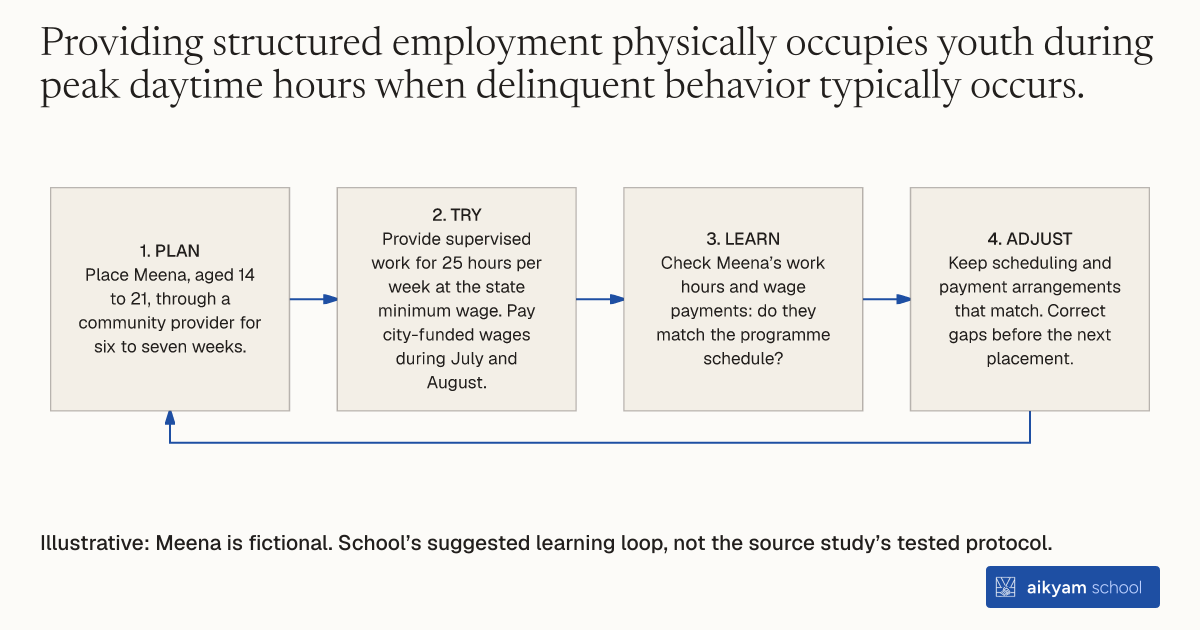
Try, learn and adjust
Check summer work schedules and wages
- Plan: Place Meena, aged 14 to 21, through a community provider for six to seven weeks.
- Try: Provide supervised work for 25 hours per week at the state minimum wage. Pay city-funded wages during July and August.
- Learn: Check Meena’s work hours and wage payments: do they match the programme schedule?
- Adjust: Keep scheduling and payment arrangements that match. Correct gaps before the next placement.
Illustrative: Meena is fictional. School’s suggested learning loop, not the source study’s tested protocol.
See source →School’s suggested, untested loop. Observe work hours and wage payments; this does not measure crime effects.
How
When to use
Youth face high rates of summer idleness and delinquency when school is out of session. Providing paid structured employment creates routine and reduces illegal behavior. This method serves youth aged 14 to 21 in urban municipalities.
Deliver fully subsidized summer employment and structured work schedules to youth through community providers.
- Municipal youth development agencies contract with non-profit providers to manage program enrollment and job placements.
- Eligible youth aged 14 to 21 apply to providers in their local communities.
- Providers place enrolled youth into subsidized jobs across non-profit, government, and private sector employers for six to seven weeks.
- Employers supervise youth for 25 hours per week at the state minimum wage.
- Program administrators distribute full wage payouts subsidized by city funding throughout July and August.
Why it works
This structure removes idle time and reduces opportunities to engage in criminal activities.
Example
The New York City Department of Youth and Community Development delivered 25 hours per week of subsidized summer work for six to seven weeks to youth aged 14 to 21 between 2005 and 2008. Youth earned state minimum wage across non-profit, government, and private sector placements at an average program cost of $1,403 per participant. Participation reduced program summer arrests by 17 percent and felony arrests by 23 percent overall.
About the study
Participants
163,447 program applicants aged 16 to 21 (45 percent male, primarily Black and Latino, 91 percent U.S. citizens), New York City.
Study Design
Two-stage least squares instrumental variable design using randomized lottery outcomes linked to state criminal justice records across four program cohorts (2005–2008).
Results
SYEP participation reduced the probability of summer arrest by 0.128 percentage points (a 17 percent drop) and felony arrests by 0.072 percentage points (a 23 percent drop). Among at-risk youth with prior arrests, participation reduced summer arrests by 2.75 percentage points (a 23 percent drop) and total convictions by 2.09 percentage points (a 52 percent drop).