Try, learn and adjust
Check spare parts against stock requirements
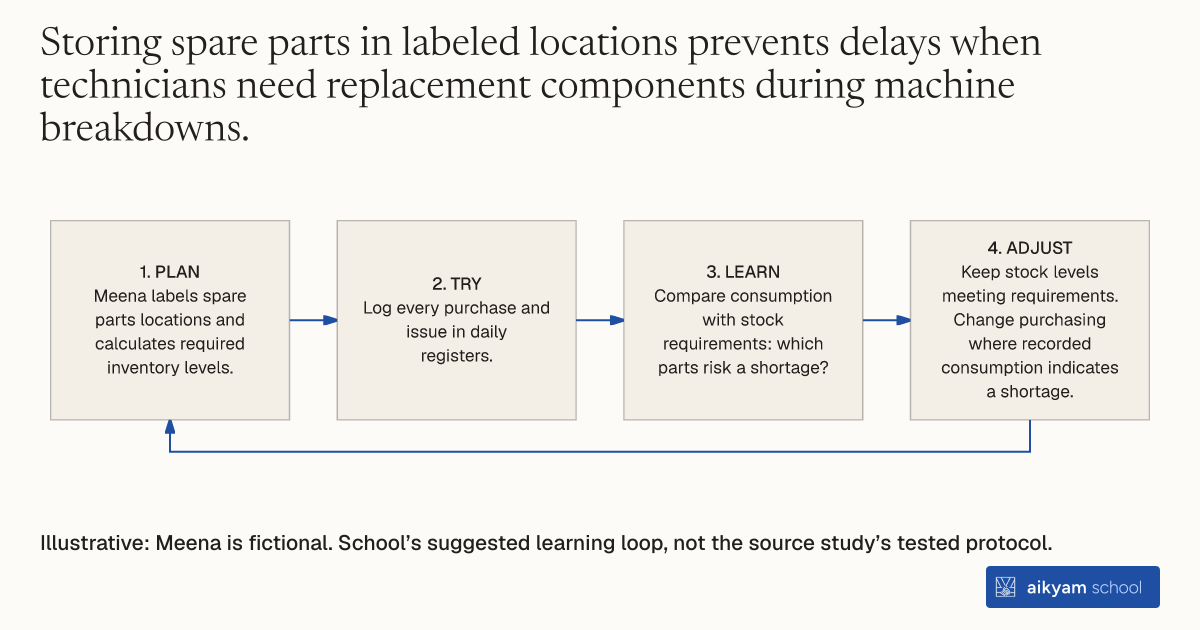
- Plan: Meena labels spare parts locations and calculates required inventory levels.
- Try: Log every purchase and issue in daily registers.
- Learn: Compare consumption with stock requirements: which parts risk a shortage?
- Adjust: Keep stock levels meeting requirements. Change purchasing where recorded consumption indicates a shortage.
Illustrative: Meena is fictional. School’s suggested learning loop, not the source study’s tested protocol.
See source →Observe labelled locations, daily transactions and inventory requirements. School suggests this learning loop; it is not the source’s tested procedure.
How
When to use
Factory spare parts stores frequently lack demarked storage locations, labeled shelves, and scientific inventory norms. Plant staff purchase spare parts without tracking consumption or defining minimum stock levels, leading to stockouts during loom breakdowns or capital tied up in redundant spares. This method helps factory managers organize spare parts systematically, establish inventory norms, and log all purchases and consumption.
Organize spare parts in demarked, labeled storage zones and establish scientific inventory norms while tracking consumption and purchases.
- Factory storekeepers arrange spare parts on shelves with clear labels and demarked physical locations.
- Operations managers use scientific methods to calculate optimal inventory norms for each spare part type.
- Store staff log every spare part purchase and issue into daily tracking registers or inventory logs.
- Plant managers review spare parts consumption against inventory norms to prevent unexpected shortages during machine repairs.
Why it works
Setting inventory norms and logging consumption ensures critical parts remain in stock without tying up capital in excessive spare parts inventory.
Example
International consultants guided Indian cotton textile plants near Mumbai to organize unlabeled spare parts shelves and set inventory norms, increasing adoption of demarked spare parts storage from 0% to 16.7% across treatment plants.
About the study
Participants
28 plants across 17 large, family-owned cotton textile weaving firms in Tarapur and Umbergaon near Mumbai, India, averaging 273 employees and $7.45 million in annual sales per firm.
Study Design
Randomized controlled trial providing 11 treatment firms with 5 months of management consulting and 6 control firms with 1 month of diagnostic consulting, measuring outcomes weekly across ~100 weeks.
Results
Organizing inventory and spare parts management contributed to a 21.7% reduction in yarn inventory (p = 0.060), a 9.4% increase in output (p = 0.026), and a 16.6% increase in total factor productivity (p = 0.061).