Try, learn and adjust
Check yarn stock against inventory limits
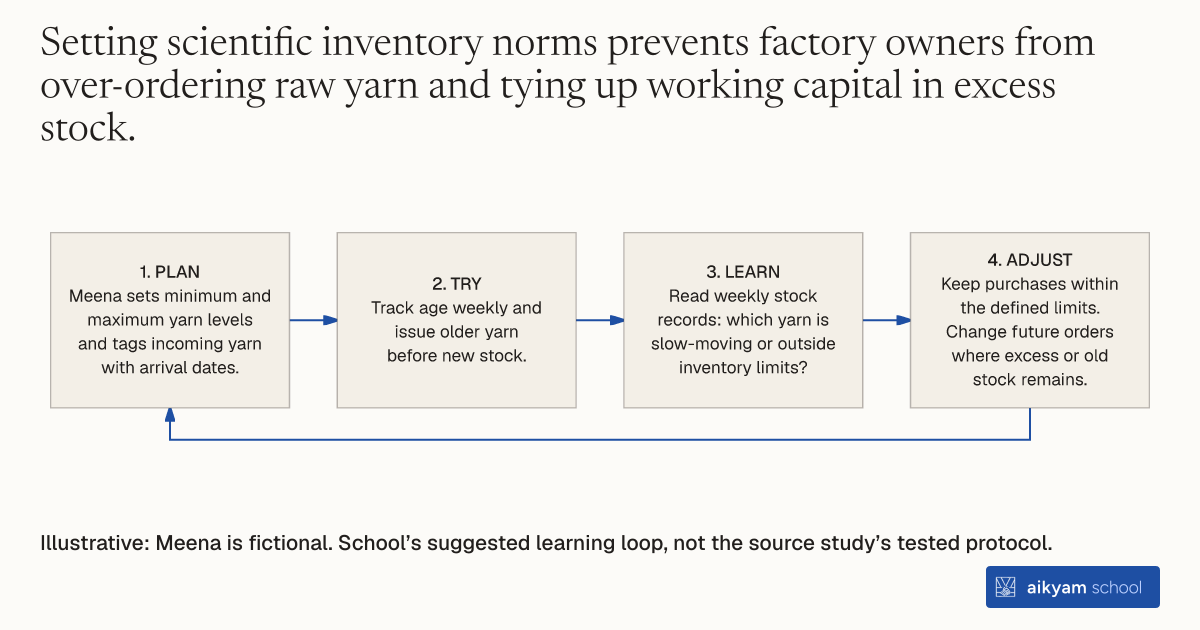
- Plan: Meena sets minimum and maximum yarn levels and tags incoming yarn with arrival dates.
- Try: Track age weekly and issue older yarn before new stock.
- Learn: Read weekly stock records: which yarn is slow-moving or outside inventory limits?
- Adjust: Keep purchases within the defined limits. Change future orders where excess or old stock remains.
Illustrative: Meena is fictional. School’s suggested learning loop, not the source study’s tested protocol.
See source →Observe yarn age, stock levels and purchasing orders. School suggests this learning loop; it is not the source’s tested procedure.
How
When to use
Textile factories often hold four months of raw yarn stock without knowing optimal reserve thresholds. Storekeepers store yarn cones across multiple warehouse locations without tracking material age, causing yarn to degrade and tying up cash in dead stock. This method helps factory owners establish minimum and maximum inventory norms and track yarn aging to eliminate excess stock.
Establish scientific inventory norms for yarn stocks and implement aging tracking procedures to eliminate dead stock.
- Operations managers use scientific calculations to define optimal minimum and maximum yarn inventory norms for each yarn type.
- Warehouse clerks tag yarn cones with arrival dates upon receipt at the factory storage facilities.
- Inventory staff log yarn age and monitor stock aging weekly using computerized tracking software.
- Storekeepers implement a first-in, first-out allocation system to ensure older yarn cones are issued to looms before newly arrived stock.
- Plant managers review aging inventory records weekly to identify slow-moving stock and adjust future yarn purchasing orders.
Why it works
Tracking the age of yarn stock allows plant managers to identify dead stock and use older yarn before yarn quality degrades.
Example
International consultants guided managers at woven cotton textile plants near Mumbai, India to establish scientific yarn inventory norms and set up aging tracking systems, raising yarn aging monitoring adoption from 0% to 53.8% across treatment plants.
About the study
Participants
28 plants across 17 large, family-owned cotton textile weaving firms in Tarapur and Umbergaon near Mumbai, India, averaging 273 employees and $7.45 million in annual sales per firm.
Study Design
Randomized controlled trial providing 11 treatment firms with 5 months of management consulting and 6 control firms with 1 month of diagnostic consulting, tracking weekly inventory data across ~100 weeks.
Results
Adopting scientific inventory norms and aging yarn tracking contributed to a 21.7% reduction in yarn inventory (p = 0.060), equivalent to roughly $100,000 per plant, while scientific yarn inventory norm adoption rose from 0% to 8.3% and yarn aging monitoring adoption rose from 0% to 53.8% in treatment plants.