Research design
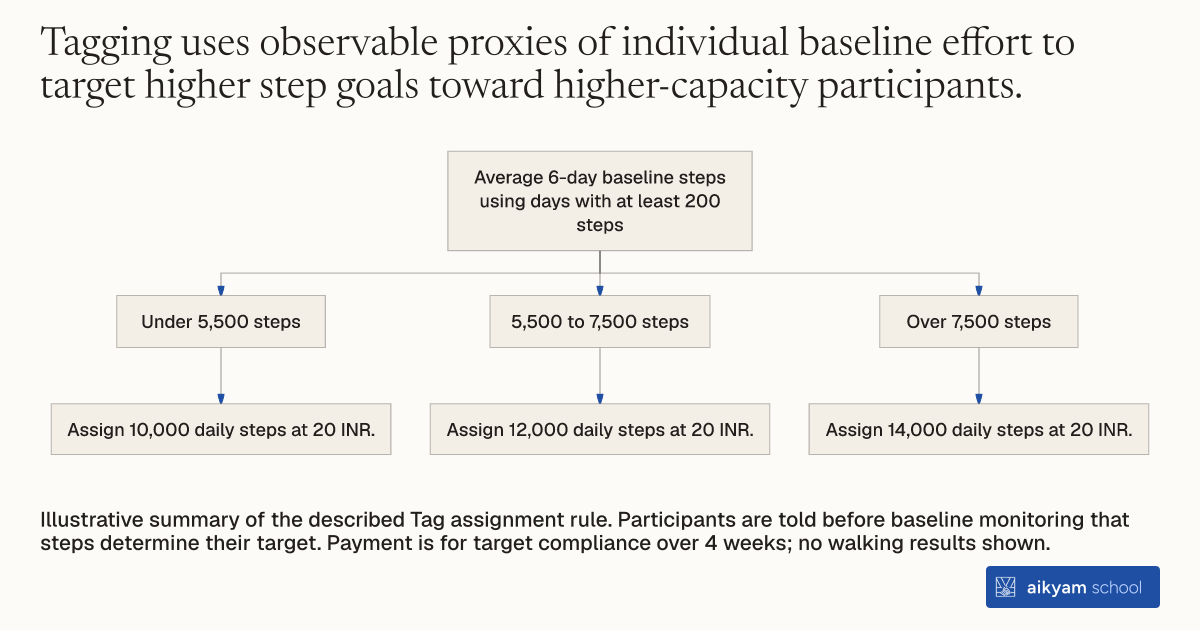
Assign targets from baseline walking
Average 6-day baseline steps using days with at least 200 steps
- Under 5,500 steps
- Assign 10,000 daily steps at 20 INR.
- 5,500 to 7,500 steps
- Assign 12,000 daily steps at 20 INR.
- Over 7,500 steps
- Assign 14,000 daily steps at 20 INR.
Illustrative summary of the described Tag assignment rule. Participants are told before baseline monitoring that steps determine their target. Payment is for target compliance over 4 weeks; no walking results shown.
See source →How
When to use
Health incentive programs seek to tailor step targets to participant effort costs without relying on self-selected contract menus. Observing baseline activity levels before assigning contracts allows program administrators to tag participants by their default physical activity type. Assigning customized step targets based on pre-contract walking levels aligns program targets with individual capabilities.
Assign personalized exercise targets by measuring participants' baseline activity levels and mapping them to specific contract tiers using observable thresholds.
- Distribute pedometers to participants during an initial household visit and instruct them to walk as normal for six days.
- Inform participants prior to the monitoring period that their recorded baseline steps will determine their future contract target.
- Calculate each participant's average daily baseline steps across days with at least 200 recorded steps.
- Assign participants walking under 5,500 baseline steps to a 10,000 daily step target paying 20 INR.
- Assign participants walking between 5,500 and 7,500 baseline steps to a 12,000 daily step target paying 20 INR.
- Assign participants walking over 7,500 baseline steps to a 14,000 daily step target paying 20 INR.
Why it works
Customizing targets based on baseline walking increases total steps taken without increasing payment rates for inframarginal activity.
Example
In Coimbatore, Tamil Nadu, India, researchers assigned 990 adults with diabetes or hypertension to step targets based on their six-day baseline walking averages, resulting in an average daily step count of 8,175 steps during the four-week contract period.
About the study
Participants
990 participants in the Tag group out of 6,882 total enrolled adults aged 30 to 65 (mean age 49, 37% female, 31% diabetic, 32% hypertensive) in urban Coimbatore, Tamil Nadu, India.
Study Design
Randomized controlled trial benchmarking arm assigning 10,000, 12,000, or 14,000 step targets paying 20 INR based on unmanipulated baseline step thresholds (<5,500; 5,500–7,500; >7,500) over 4 weeks.
Results
Tagging participants based on baseline steps increased daily walking by 455 steps relative to the one-size-fits-all 12,000 step target (Fixed Medium) and paid an average daily incentive of 6.09 INR per person.