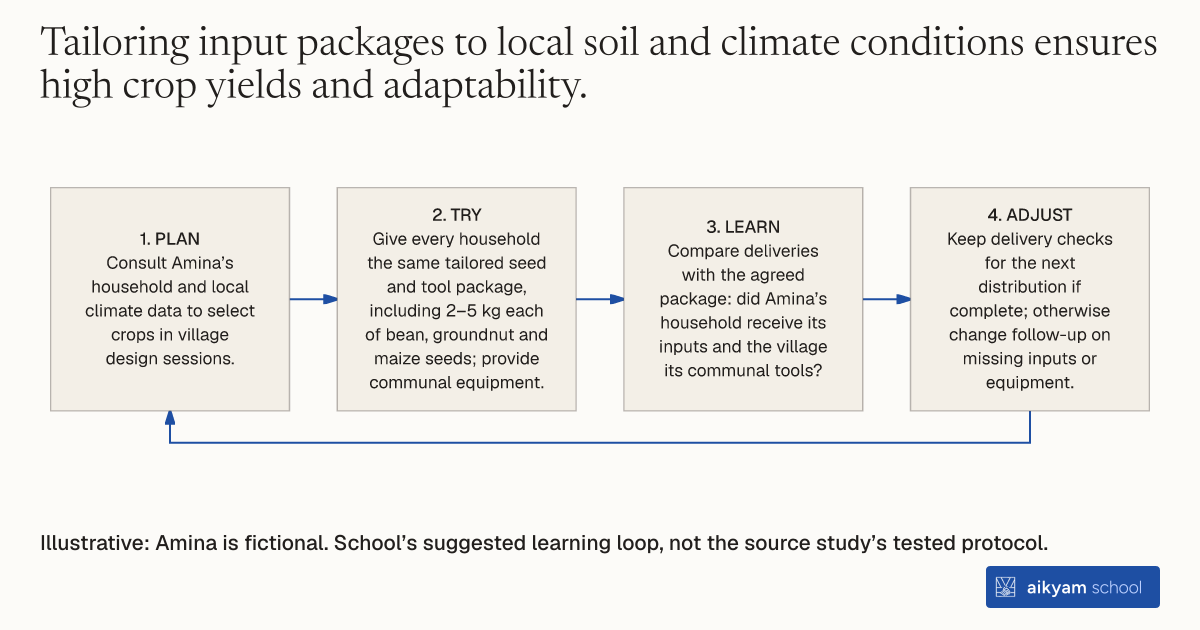
Try, learn and adjust
Check seed and tool packages match local design
- Plan: Consult Amina’s household and local climate data to select crops in village design sessions.
- Try: Give every household the same tailored seed and tool package, including 2–5 kg each of bean, groundnut and maize seeds; provide communal equipment.
- Learn: Compare deliveries with the agreed package: did Amina’s household receive its inputs and the village its communal tools?
- Adjust: Keep delivery checks for the next distribution if complete; otherwise change follow-up on missing inputs or equipment.
Illustrative: Amina is fictional. School’s suggested learning loop, not the source study’s tested protocol.
See source →School’s suggested, untested learning loop. Observe agreed package receipt and communal provision; this check does not establish yield or sales gains.
How
When to use
Rural smallholder agricultural communities in low-income regions often face low crop yields and limited dietary diversity due to a lack of high-yield seeds and farming tools. Providing tailored, household- and village-level input packages helps farming households expand crop production for both home consumption and commercial sales. This approach is intended for agrarian communities where subsistence farming is the primary livelihood.
Provide tailored high-yield seeds, farm tools, and communal processing equipment to all households in rural villages based on localized needs and climate data.
- Conduct village design sessions combining localized climatic data—such as altitude, soil type, temperature, and rainfall—with household consultations to select target crops.
- Distribute household input packages containing 2–5 kg each of high-yield bean, groundnut, and maize seeds, 0.25 bags of Irish potatoes, fruit and vegetable seeds, and perennial seedlings like coffee to every household.
- Supply individual households with tools and equipment including hoes, forks, spades, and sacks.
- Deliver communal tools and machinery to the village, including pangas, wheelbarrows, water drums, watering cans, spray pumps, milling machines, and coffee pulpers.
Why it works
Supplying both individual farm tools and communal processing machinery enables households to increase agricultural output and diversify into commercial crops.
Example
In rural western Uganda, Raising the Village distributed tailored seed packages—including 2–5 kg of bean, groundnut, and maize seeds—and farm tools to all households in treated villages, increasing monthly crop sales by USD 21.46 PPP.
About the study
Participants
3,852 households across 335 villages in Kagadi and Kyenjojo districts, western Uganda, where 35% of households fall below the $2.15 PPP daily poverty line post-harvest and 65% during the lean season.
Study Design
Clustered randomized controlled trial across 114 village clusters covering 335 villages, comparing a universal livelihoods program to a pure control group.
Results
Farm crop sales increased by 27% (USD 21.46 PPP per month, p < 0.01), fertilizer use increased by 16.55 kg in Season 1 and 9.10 kg in Season 2, and land area planted expanded by 0.16 acres in Season 1 and 0.19 acres in Season 2.