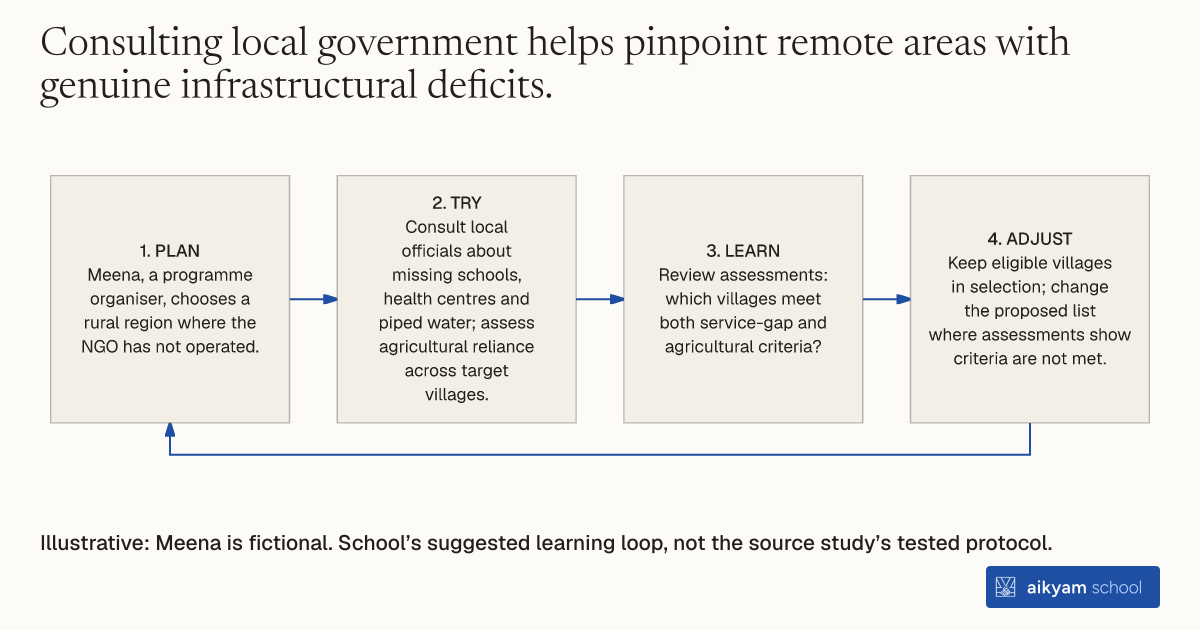
Try, learn and adjust
Check village eligibility before inclusion
- Plan: Meena, a programme organiser, chooses a rural region where the NGO has not operated.
- Try: Consult local officials about missing schools, health centres and piped water; assess agricultural reliance across target villages.
- Learn: Review assessments: which villages meet both service-gap and agricultural criteria?
- Adjust: Keep eligible villages in selection; change the proposed list where assessments show criteria are not met.
Illustrative: Meena is fictional. School’s suggested learning loop, not the source study’s tested protocol.
See source →School’s suggested, untested learning loop. Observe infrastructure and agricultural eligibility; selection is not evidence of programme impact.
How
When to use
Rural communities in low-income regions often lack basic government infrastructure and rely heavily on subsistence agriculture. Local governments and development organisations need an objective method to identify underserved communities that will benefit most from universal livelihood interventions. This approach identifies rural villages with limited public services where households depend on farming for income and food.
Identify and select eligible rural communities for universal poverty interventions through systematic local government consultation and infrastructure assessments.
- Select a rural target region where the NGO has not previously operated, such as Kagadi and Kyenjojo districts in western Uganda.
- Meet with local government officials across target sub-counties to identify villages lacking basic public services like schools, health centers, and piped water.
- Screen identified villages to confirm that resident households rely on agriculture for both income and consumption.
- Evaluate all villages within the sub-counties against these criteria to establish the final set of eligible communities.
Why it works
Targeting agrarian communities ensures that universal agricultural and livestock interventions align directly with local economic needs.
Example
Raising the Village evaluated 395 villages across 12 sub-counties in Kagadi and Kyenjojo districts in western Uganda, determining that 335 villages met all eligibility criteria.
About the study
Participants
3,852 households across 335 villages in Kagadi and Kyenjojo districts, western Uganda, where 35% of households fall below the \$2.15 PPP daily poverty line post-harvest and 65% during the lean season.
Study Design
Clustered randomized controlled trial across 114 village clusters covering 335 villages, comparing a universal livelihoods program to a pure control group.
Results
Out of 395 villages assessed across 12 sub-counties, 335 met the eligibility criteria and were included in the study, representing a 100% inclusion rate of eligible villages.