Try, learn and adjust
Check veterinarian training covers livestock care
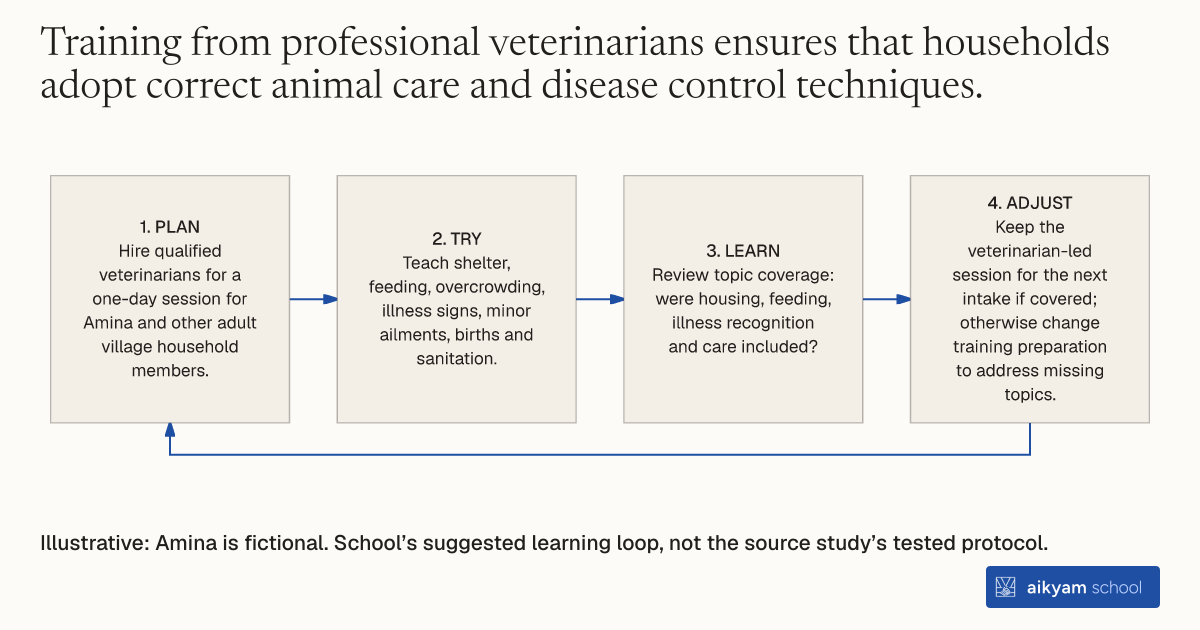
- Plan: Hire qualified veterinarians for a one-day session for Amina and other adult village household members.
- Try: Teach shelter, feeding, overcrowding, illness signs, minor ailments, births and sanitation.
- Learn: Review topic coverage: were housing, feeding, illness recognition and care included?
- Adjust: Keep the veterinarian-led session for the next intake if covered; otherwise change training preparation to address missing topics.
Illustrative: Amina is fictional. School’s suggested learning loop, not the source study’s tested protocol.
See source →School’s suggested, untested learning loop. Observe qualified delivery and topic coverage. This suggested loop is not veterinary treatment guidance or evidence of separate livestock-training effects.
How
When to use
Rural smallholder farming families often experience animal deaths and low livestock earnings because they lack veterinary knowledge and modern animal care skills. Providing expert training teaches households how to manage livestock housing, feed animals properly, and prevent disease outbreaks. This method suits rural poverty reduction programs that introduce livestock rearing to farming communities.
Deliver structured livestock management training to all village households using qualified professional veterinarians.
- Hire qualified veterinarians to conduct a one-day training session for all adult household members in the village.
- Teach households to build proper animal shelters and pigsties to protect livestock from harsh weather and disease.
- Instruct families on proper feeding methods and strategies to prevent overcrowding in livestock enclosures.
- Train household members to inspect animals regularly for early symptoms of sickness or physical weakness.
- Guide participants on how to treat minor ailments, handle livestock births, and maintain sanitary animal environments.
Why it works
Early disease detection and proper housing reduce animal sickness and increase livestock productivity across the community.
Example
In rural western Uganda, Raising the Village hired qualified veterinarians to deliver a one-day livestock training session to all households in treated villages, increasing total livestock holdings by USD 183.734 PPP.
About the study
Participants
3,852 households across 335 villages in Kagadi and Kyenjojo districts, western Uganda, where 35% of households fall below the \$2.15 PPP daily poverty line post-harvest and 65% during the lean season.
Study Design
Clustered randomized controlled trial across 114 village clusters covering 335 villages, comparing a universal livelihoods program to a pure control group.
Results
Livestock holdings value increased by USD 183.734 PPP (p < 0.01), monthly income from livestock and animal product sales increased by USD 4.459 PPP (p < 0.01), and the share of households earning livestock income increased by 0.084 (p < 0.01).