Try, learn and adjust
Check stamped attendance records are complete
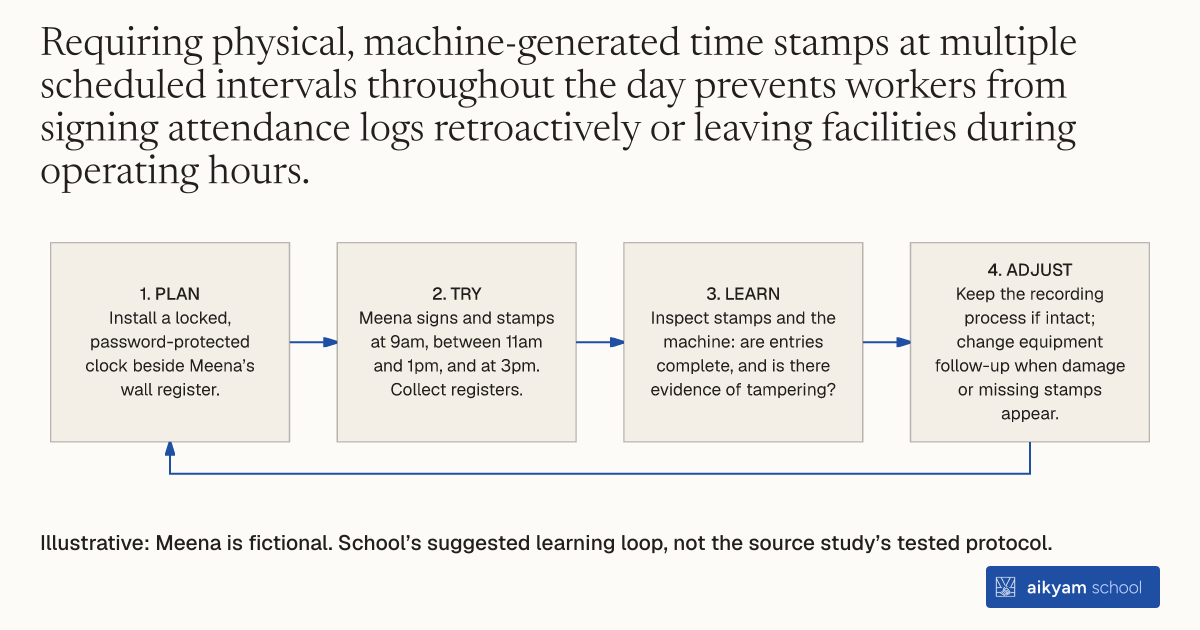
- Plan: Install a locked, password-protected clock beside Meena’s wall register.
- Try: Meena signs and stamps at 9am, between 11am and 1pm, and at 3pm. Collect registers.
- Learn: Inspect stamps and the machine: are entries complete, and is there evidence of tampering?
- Adjust: Keep the recording process if intact; change equipment follow-up when damage or missing stamps appear.
Illustrative: Meena is fictional. School’s suggested learning loop, not the source study’s tested protocol.
See source →Observe stamp times, missing entries and machine condition; early attendance gains later faded. School suggests this learning loop; it was not tested by the source.
How
When to use
Public health clinics in developing regions experience high levels of nurse absenteeism, leaving primary care facilities unstaffed. Conventional paper registers allow providers to falsify attendance entries retroactively. Install password-protected, locked time-stamping machines at health subcenters to collect verifiable physical proof of worker presence throughout operating hours.
Deploy password-protected time-stamping machines in rural health facilities to log verified provider attendance throughout the workday.
- Mount time/date-stamping machines locked inside caddies and secured to walls inside public subcenters.
- Secure the machines with passwords and physical locks to prevent unauthorized tampering.
- Attach a paper register directly adjacent to each time clock machine.
- Require the healthcare provider to sign and time-stamp the register three times daily at 9am, between 11am and 1pm, and at 3pm.
- Collect the physical stamped registers periodically to verify actual attendance against duty requirements.
Example
In Udaipur District, India, Seva Mandir installed locked, password-protected time-stamping machines at 49 health subcenters staffed by Assistant Nurse Midwives. Nurses were required to sign and time-stamp a wall register three times a day, which initially increased nurse presence on monitored days by 15 percentage points in two-nurse subcenters and 29 percentage points on Mondays in single-nurse subcenters.
About the study
Participants
Assistant Nurse Midwives at 49 public health subcenters serving 135 villages in Udaipur District, Rajasthan, India.
Study Design
Randomized controlled trial tracking nurse attendance using tamper-proof time/date-stamping machines and paper registers signed three times daily.
Results
Nurse presence initially increased by 15 percentage points in two-nurse subcenters and 29 percentage points in single-nurse subcenters, though differences faded after six to fourteen months as machines were intentionally broken and administrators excused absences.