Try, learn and adjust
Check attendance records before monthly pay deductions
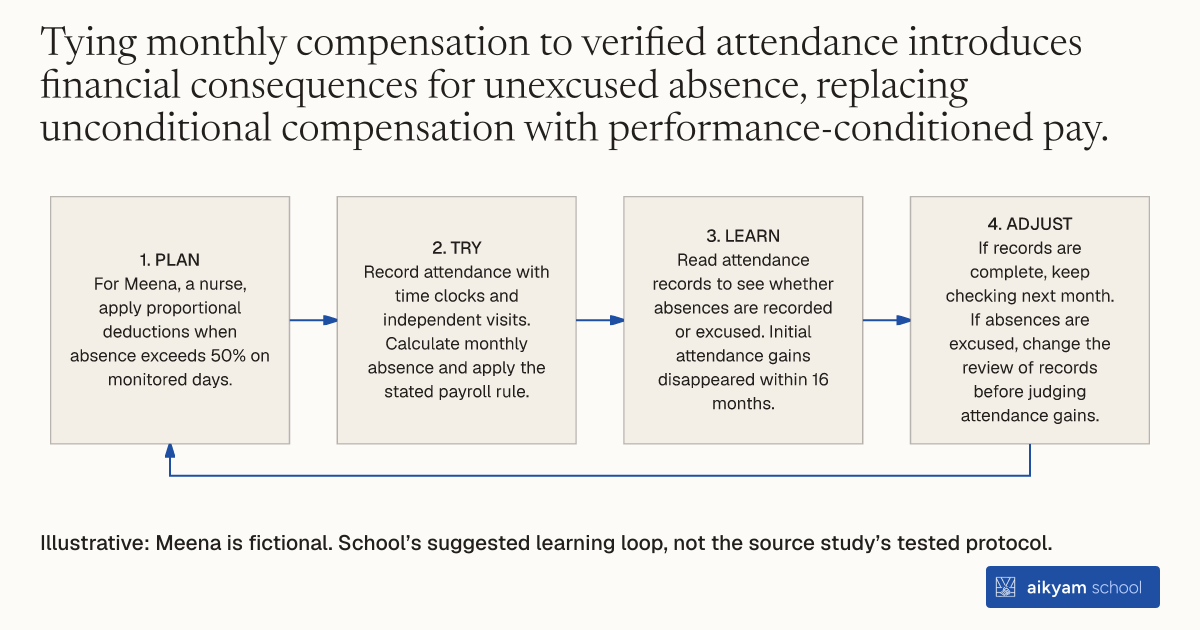
- Plan: For Meena, a nurse, apply proportional deductions when absence exceeds 50% on monitored days.
- Try: Record attendance with time clocks and independent visits. Calculate monthly absence and apply the stated payroll rule.
- Learn: Read attendance records to see whether absences are recorded or excused. Initial attendance gains disappeared within 16 months.
- Adjust: If records are complete, keep checking next month. If absences are excused, change the review of records before judging attendance gains.
Illustrative: Meena is fictional. School’s suggested learning loop, not the source study’s tested protocol.
See source →Observe monitored attendance, excused absences and payroll deductions; initial gains alone do not show lasting improvement.
How
When to use
Public health clinics experience persistent staff absence when salaries remain completely unchanged regardless of attendance. Fixed monthly compensation without monitoring creates no financial penalty for missing work. Deduct pay proportionally from staff salaries whenever worker absences exceed a specified monthly limit.
Deduct pay directly from monthly salaries in proportion to recorded unexcused absences.
- Define an maximum allowable absence percentage for healthcare workers on monitored days.
- Log daily staff attendance using tamper-proof time clocks and independent field visits.
- Calculate the total percentage of monitored workdays missed by each provider at month end.
- Reduce the monthly pay proportionally to the number of recorded absences for any provider exceeding the threshold.
- Disburse reduced salary payments through official government payroll.
Example
In Udaipur District, India, the district health administration reduced the pay of Assistant Nurse Midwives absent for more than 50 percent of monitored days proportionally to their missed shifts. This pay-incentive structure initially increased nurse attendance on monitored Mondays from 30 percent in comparison centers to 59 percent in treatment centers.
About the study
Participants
Assistant Nurse Midwives at public health subcenters serving 135 villages in Udaipur District, Rajasthan, India.
Study Design
Randomized controlled trial evaluating tamper-proof time-clock monitoring tied to proportional salary deductions for staff absent over 50 percent of monitored days.
Results
Threat of salary deductions initially increased nurse presence by 15 percentage points in two-nurse centers and 29 percentage points in single-nurse centers, but gains disappeared within 16 months as local administrators excused absences.